Caucasus Mountains, Georgia: Complete Guide to Kazbegi, Svaneti and Alpine Trails

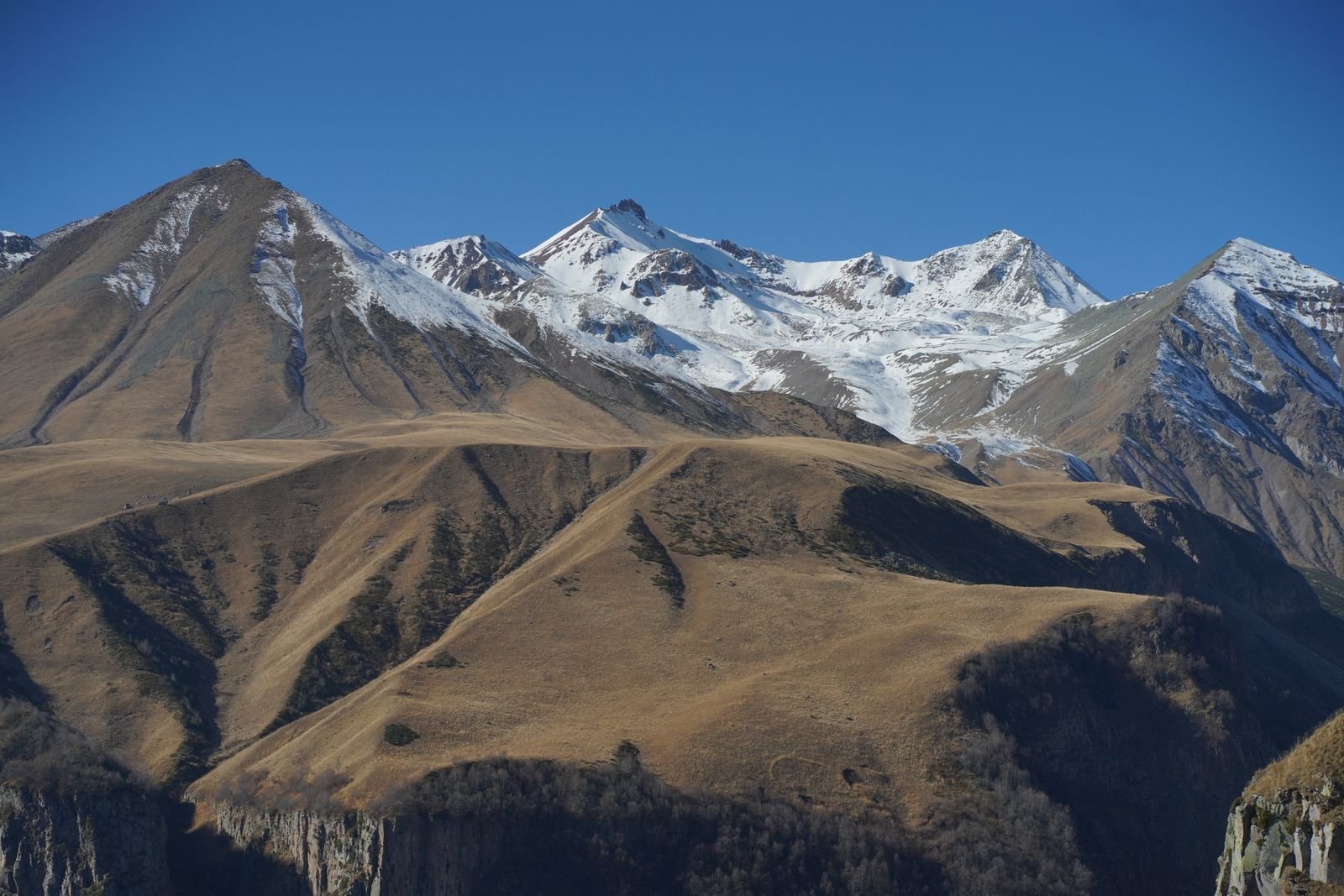
The Caucasus Mountains are one of the great mountain ranges of the world, and the Georgian side of the range is one of its most rewarding places to visit. Here, snow-capped peaks rise above alpine meadows, medieval stone towers guard remote valleys, and hiking trails lead to glaciers, lakes and villages that feel a long way from the modern world. The Caucasus Mountains, Georgia, stretch along the country’s northern border, and they offer some of the finest mountain walking in Europe, with a warmth of hospitality that is famous across the region. This guide covers the best bases, the great trails, the seasons and the practical details for a trip to the Caucasus Mountains in Georgia.
The Greater Caucasus is the range that forms the border between Georgia and Russia, and it includes Mount Elbrus, the highest peak in Europe, on the Russian side, and Mount Shkhara, the highest peak in Georgia, at 5,193 metres. The Georgian Caucasus is divided into regions, each with its own character. Kazbegi, in the north-east, is the most accessible, with the famous Gergeti Trinity Church and the road to the Russian border. Svaneti, in the north-west, is the most remote, with its tower villages of Mestia and Ushguli. Tusheti, in the east, is reached only by a dramatic mountain road in summer, and it is one of the wildest places in Europe. Together, these regions make the Caucasus Mountains in Georgia a destination that rewards the traveller who is willing to go slowly.
Kazbegi: The Gateway to the High Caucasus
Kazbegi, known locally as Stepantsminda, is the town that most visitors to the Caucasus Mountains in Georgia see first. It sits in a valley beneath Mount Kazbek, a dormant volcano that rises to 5,047 metres, and it is reached by the Georgian Military Highway from Tbilisi, a journey of about three hours that is one of the most scenic drives in the country. The town itself is small and relaxed, with guesthouses, restaurants and a growing number of hotels, and it is the base for the most famous walk in Georgia, the hike to the Gergeti Trinity Church.
The Gergeti Trinity Church sits on a hill above Kazbegi, with Mount Kazbek behind it, and it is one of the most photographed sights in the Caucasus. The walk to the church takes about two hours from the town, climbing through meadows and forest, and it is a good introduction to the mountains. For a longer day, continue to the Gergeti Glacier, a full-day hike that takes you to the foot of Mount Kazbek. Other walks from Kazbegi include the valley to the Gveleti Waterfalls, the hike to the Sno Valley and its stone heads, and the drive to the Dariali Gorge, a deep canyon on the border with Russia. Kazbegi is also a good base for multi-day treks, including the popular route from Kazbegi to Juta and over the Chaukhi Pass.
Svaneti: Towers, Glaciers and the Highest Village in Europe
Svaneti is the most distinctive region of the Caucasus Mountains in Georgia, and it is also the most remote. Its valleys are guarded by medieval stone towers, built by Svan families to protect themselves and their possessions, and its villages, Mestia and Ushguli, are UNESCO World Heritage Sites. Ushguli, at about 2,200 metres, is one of the highest permanently inhabited villages in Europe, and it sits beneath Mount Shkhara, the highest peak in Georgia. The landscape here is wilder and more dramatic than in Kazbegi, and the walking is more challenging.
The classic trek in Svaneti is the four-day walk from Mestia to Ushguli, which passes through the villages of Zhabeshi, Adishi and Iprari, with views of glaciers, peaks and alpine meadows. It is a well-marked trail, and it can be walked independently, staying in guesthouses along the way, or with a guide. Shorter walks from Mestia include the hike to the Chalaadi Glacier, the walk to the lakes above the town, and the climb to the cross above Mestia, which offers a fine view over the valley. Svaneti is reached by a long drive from Tbilisi, or by a short flight to Mestia’s small airport, and it is worth the journey. The towers, the glaciers and the hospitality of the Svan people make it one of the great mountain destinations in Europe.
Tusheti and the Wild East
Tusheti is the wildest region of the Georgian Caucasus, and it is also the hardest to reach. The only road in is the Abano Pass, a mountain road that climbs to 2,850 metres and is open only in summer, from June to September, and only to four-wheel-drive vehicles. The road is famous, and infamous, for its steep drops and narrow sections, and it is an adventure in itself. Once you arrive, Tusheti feels like a different world, with its stone villages, its alpine meadows and its ancient towers, and with almost no tourists.
The villages of Tusheti, Omalo, Dartlo and Shenako, are among the most beautiful in Georgia, and they are the base for walks to high passes, to lakes and to the remote valleys of the region. The trek from Omalo to Dartlo is a gentle introduction, and the longer trek over the Atsunta Pass to Khevsureti is one of the great multi-day hikes in the Caucasus. Tusheti is also famous for its food, its cheese and its beer, and for the hospitality of its people, who welcome visitors with a warmth that is typical of the mountains. If you want to see the Caucasus Mountains in Georgia at their wildest, Tusheti is the place to go, but allow plenty of time, because the road in and out is slow, and the weather can change quickly.
The Best Hikes in the Caucasus Mountains, Georgia
The Caucasus Mountains in Georgia offer hiking for every level, from gentle valley walks to serious multi-day treks. The walk to the Gergeti Trinity Church in Kazbegi is the most popular day hike, and it is a good introduction. The Mestia to Ushguli trek in Svaneti is the classic multi-day walk, and it is suitable for any fit walker. The trek from Kazbegi to Juta, over the Chaukhi Pass, is shorter but more challenging, with a high pass and a remote valley. The walk to the Tobavarchkhili lakes in the Egrisi Mountains, in the west, is a multi-day trek to a series of alpine lakes that are among the most beautiful in Georgia.
For experienced hikers, the Caucasus Mountains offer serious challenges, including the climb to the summit of Mount Kazbek, a glaciated peak that requires a guide, crampons and an ice axe, and the trek over the Atsunta Pass from Tusheti to Khevsureti, which takes several days and crosses a remote, high pass. Whatever your level, the key to hiking in the Caucasus is to be prepared. The weather can change quickly, the trails can be steep and rocky, and the distances can be longer than they look on the map. Carry water, food, sun protection and a rain jacket, and tell your guesthouse where you are going. The mountains are beautiful, but they demand respect.
Where to Stay in the Georgian Caucasus
Accommodation in the Caucasus Mountains in Georgia is mostly small guesthouses, and it is one of the pleasures of a trip to the mountains. The guesthouses are family-run, the food is home-cooked, and the hospitality is generous. In Kazbegi, there is a wide choice, from simple guesthouses to comfortable hotels, including the Rooms Hotel, which is famous for its view of Mount Kazbek. In Mestia, there are guesthouses, hotels and apartments, and in Ushguli, the guesthouses are simpler, but the welcome is just as warm. In Tusheti, the guesthouses are basic, with shared facilities, but they are clean and comfortable, and the food is excellent.
Book ahead in the summer, especially in Kazbegi and Mestia, when the guesthouses fill up. In the villages, your guesthouse will often be able to arrange transport, guides and horses, and it is worth asking for help, because the local knowledge is invaluable. For a wider sense of how mountain regions are travelled, our guide to the Swiss Alps shows a very different kind of alpine landscape, with trains, villages and high trails, while Mount Kilimanjaro offers a single, great mountain that can be climbed in a week. More background on the range is available on Wikipedia’s Caucasus Mountains page.
Getting to the Caucasus Mountains in Georgia
The gateway to the Caucasus Mountains in Georgia is Tbilisi, the capital, which is served by flights from Europe and the Middle East. From Tbilisi, Kazbegi is a three-hour drive on the Georgian Military Highway, and the journey is best done by marshrutka, the shared minibus, or by a private car. Svaneti is a longer journey, about eight hours by road from Tbilisi, or a short flight to Mestia. Tusheti is reached by four-wheel-drive from Telavi, in the east, and the journey takes about five hours. Within the mountains, transport is by marshrutka, by taxi or by hired four-wheel-drive, and it is worth arranging transport through your guesthouse, because the roads can be difficult and the timetables are flexible.
The Georgian Military Highway, the road to Kazbegi, is one of the great drives in the world, passing the Ananuri Fortress, the Zhinvali Reservoir and the Jvari Pass, with views of the mountains that open up as you climb. The road to Svaneti passes through the lowlands and then climbs into the mountains, and the road to Tusheti, over the Abano Pass, is one of the most dramatic roads in Europe. Allow plenty of time for all of these journeys, because the roads are slow, the scenery is distracting, and you will want to stop often.
The Best Time to Visit the Caucasus Mountains, Georgia
The best time to visit the Caucasus Mountains in Georgia is from June to September, when the snow has melted, the trails are open and the weather is at its best. July and August are the warmest months, and they are also the busiest, especially in Kazbegi and Mestia. June and September are quieter, with good weather and fewer visitors, and they are the best months for hiking. The wildflowers are at their best in June and July, and the autumn colours in September and October are spectacular, especially in the valleys.
Winter in the Caucasus Mountains is cold and snowy, and it is a different kind of destination. The ski resort of Gudauri, on the Georgian Military Highway, is popular in winter, and the mountains are beautiful under snow, but the hiking trails are closed and the roads to Tusheti and to the high valleys are impassable. Spring, from April to May, is a time of melting snow and high rivers, and it is not the best time for hiking, though the low valleys are green and beautiful. Whatever the season, check the weather before you hike, because the mountains can change quickly, and the passes can be closed by snow even in summer.
Practical Tips for Visiting the Georgian Caucasus
A few practical tips will make your trip to the Caucasus Mountains in Georgia smoother. Bring cash, because many guesthouses and small shops do not accept cards, and the ATMs are limited in the mountains. Bring a good map, because the trails are not always well marked, and a GPS device or a phone with offline maps is useful. Wear proper hiking boots, because the trails are steep and rocky, and carry a rain jacket, because the weather can change in an hour. Learn a few words of Georgian, because the people you meet will appreciate it, and the hospitality you receive will be warmer for it.
Respect the local culture. The mountains of Georgia are home to ancient churches, to sacred sites and to a way of life that has survived for centuries. Dress modestly in churches, ask before photographing people, and accept the hospitality that is offered to you, because to refuse it is considered rude. The supra, the traditional Georgian feast, is a central part of the culture, and if you are invited to one, accept, eat well and drink the wine that is offered. The Caucasus Mountains in Georgia are a place where the landscape and the people are inseparable, and the best trips are those that take time to meet both.
Frequently Asked Questions
How many days do you need in the Caucasus Mountains, Georgia?
A week is a good minimum. It gives you time for Kazbegi, for a multi-day trek in Svaneti, and for a day in Tbilisi. With two weeks you can add Tusheti, and with three days you can see Kazbegi and the Gergeti Trinity Church, but you will only have scratched the surface.
Is hiking in the Caucasus Mountains safe?
Yes, hiking in the Georgian Caucasus is safe for a prepared walker. The trails are well used, the guesthouses are welcoming, and the people are helpful. The main risks are the weather, the altitude and the remoteness, so be prepared, carry water and food, and tell your guesthouse where you are going.
Do you need a guide in the Caucasus Mountains?
For the main trails, such as Mestia to Ushguli and the Gergeti Trinity Church, you do not need a guide. For the high passes, for the climb to Mount Kazbek and for the remote regions such as Tusheti, a guide is recommended, and for the summit of Kazbek it is essential.
When is the best time to visit the Caucasus Mountains, Georgia?
June to September is the best time for hiking, with July and August the warmest and busiest months. June and September are quieter, with good weather and fewer visitors. Winter is for skiing, and spring is for the low valleys.
How do you get to Svaneti?
Svaneti is reached by road from Tbilisi, a journey of about eight hours, or by a short flight to Mestia’s small airport. The flight is quick and scenic, but it is weather-dependent and it books up early, so book in advance.
Conclusion
The Caucasus Mountains, Georgia, are one of the great mountain destinations in the world, and they are still, by the standards of the Alps or the Himalayas, relatively undiscovered. Kazbegi, Svaneti and Tusheti each offer a different face of the mountains, from the famous church beneath Mount Kazbek to the tower villages of Svaneti and the wild valleys of Tusheti. Go with time to spare, walk the trails, stay in the guesthouses and accept the hospitality that is offered. If you do, the Caucasus Mountains in Georgia will not just be a place you visited. They will be a place you remember, and a place you will want to return to, in a different season, to see them in a different light.