Gullfoss, Iceland: Complete Guide to the Golden Falls, the Golden Circle and the Best Time to Visit

Gullfoss is the waterfall that taught Iceland to love its rivers. The name means Golden Falls, and on a sunny day you can see why: the spray catches the light and throws rainbows over the two-tiered cascade, and the water itself glows gold against the dark basalt. Gullfoss is one of the three stops of Iceland’s Golden Circle, and it is the most visited waterfall in the country, yet it still has the power to silence a crowd.
This guide covers everything you need to plan a visit to Gullfoss, from the falls themselves and their history to the best viewpoints, the Golden Circle route, the best time to visit, where to stay, and how to get there from Reykjavik. Whether you come in the midnight sun of summer or the blue ice of winter, Gullfoss is a waterfall that rewards the journey.
Gullfoss is more than a pretty cascade. It is a piece of Icelandic history, saved from a hydroelectric dam by the determination of one woman, and a place that shows the raw power of the country’s rivers. Standing on the path above the falls, with the spray on your face and the roar in your ears, you understand why Icelanders fought to keep this river wild.
Where Gullfoss Is and What Makes It Special
Gullfoss sits on the Hvita river in the Haukadalur valley of south-west Iceland, about 115 kilometres north-east of Reykjavik. The river, whose name means white river, is fed by the Langjokull glacier, and it carries glacial meltwater across the highlands before dropping into a deep canyon at Gullfoss. The falls are the centrepiece of the Golden Circle, the classic day trip from Reykjavik that also takes in Thingvellir National Park and the Geysir geothermal area.
What makes Gullfoss special is its shape. The river turns a sharp right angle and then plunges in two steps, first 11 metres and then 21 metres, into a canyon 70 metres deep and 2.5 kilometres long. The second drop is hidden from the upper viewpoint, so the river seems to simply vanish into the earth, which is why the first visitors to Gullfoss thought the falls were bottomless. The effect is dramatic and unlike any other waterfall in Iceland.
Gullfoss is also special for its history. In the early 1900s, foreign investors wanted to dam the Hvita river for hydroelectric power, and the falls were nearly lost. Sigridur Tomasdottir, the daughter of the farmer who owned the land, fought the dam in the courts for years, walking barefoot to Reykjavik to argue her case, and she is credited with saving Gullfoss. A stone memorial to her stands near the falls, and her story is part of every visit.
The Falls: Two Tiers and a Hidden Canyon
Gullfoss is a two-tiered waterfall, and each tier has its own character. The upper tier is a broad, 11-metre drop across a curved ledge, where the river spreads out and the water turns white and gold. The lower tier is a steeper, 21-metre plunge into the canyon, and it is the more powerful of the two, throwing up a constant cloud of spray that soaks the viewing paths on windy days.
The canyon below the falls is one of the most impressive features of Gullfoss. Carved by the river over thousands of years, it is 70 metres deep and its walls are lined with basalt columns and green moss. The river continues through the canyon for 2.5 kilometres before widening again, and the whole gorge is a reminder of how much power a glacial river carries.
The flow of the Hvita varies with the season. In summer, when the glacier melts fastest, the river carries up to 140 cubic metres of water per second, and the falls are at their most powerful. In winter, the flow drops and the falls partly freeze, with ice forming on the rocks and the spray turning to frost on the railings. Both seasons are spectacular, and both are worth seeing.
The Best Viewpoints at Gullfoss
Gullfoss has two main viewpoints, and both are worth visiting. The upper viewpoint, by the car park and the visitor centre, looks down the river and across the upper tier, and it is the best place to see the whole shape of the falls, including the sharp bend in the river. On a sunny day, the rainbow forms over the upper tier, and the view from here is the classic Gullfoss photograph.
The lower viewpoint is reached by a path that descends from the upper level to a platform beside the lower tier. This is the closer, wetter, and more thrilling view: the falls are right in front of you, the spray fills the air, and the roar is enormous. Bring a waterproof jacket and a cover for your camera, because you will get wet, especially on a windy day.
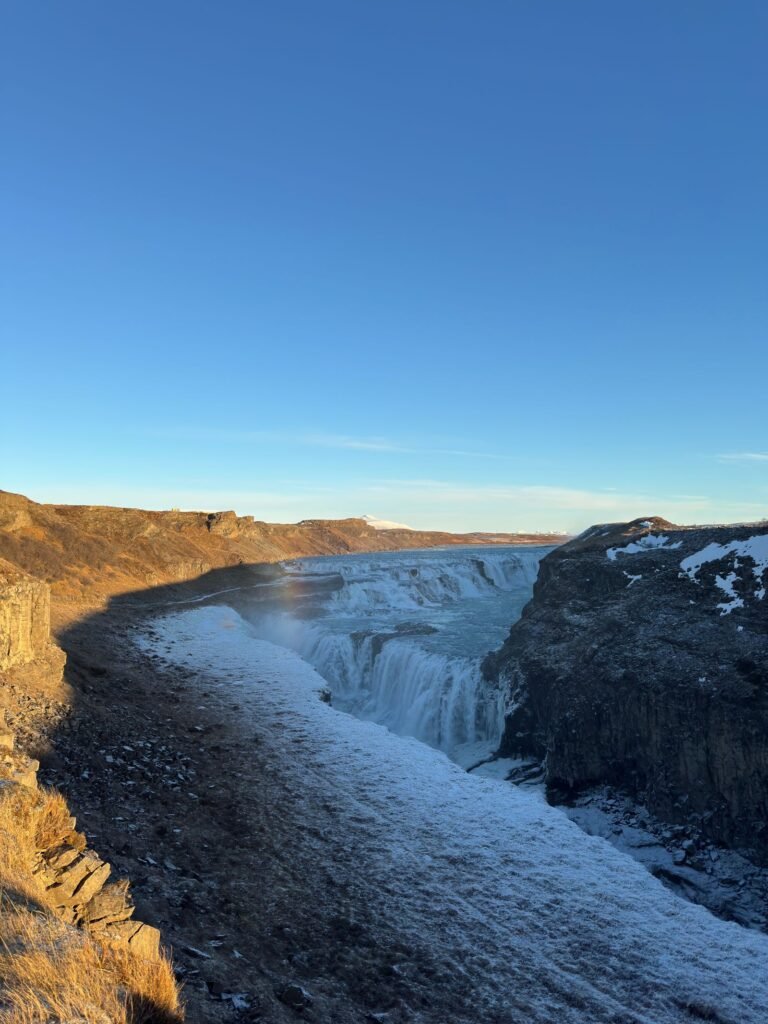
There is also a longer path that follows the canyon downstream, with views of the gorge and the river below the falls. The paths are well maintained, with steps and railings, but they can be icy in winter, and crampons or sturdy boots are recommended. Stay on the marked paths and behind the railings: the rocks are slippery, the spray makes the ground wet, and the canyon is deep.
The Golden Circle: Gullfoss, Thingvellir and Geysir
Gullfoss is the third stop of the Golden Circle, the most popular day trip in Iceland, and the three stops make a perfect introduction to the country. Thingvellir National Park, the first stop, is where the North American and Eurasian tectonic plates meet, and where the world’s oldest parliament, the Althing, was founded in 930 AD. The rift valley, with its cliffs and clear water, is a UNESCO World Heritage Site.
Geysir, the second stop, is the geothermal area that gave the word geyser to the world. The Great Geysir itself is mostly dormant, but its neighbour Strokkur erupts every few minutes, shooting boiling water 20 metres into the air. The area is full of hot springs, mud pots, and steam vents, and the smell of sulphur hangs in the air.
The Golden Circle is about 300 kilometres in total, and it can be driven in a day from Reykjavik, with stops at Thingvellir, Geysir, and Gullfoss, plus the crater lake at Kerid and the waterfall at Faxi if you have time. Guided bus tours run daily from Reykjavik, but a hire car gives you the freedom to linger at Gullfoss, which is the stop that most visitors wish they had more time at.
The Best Time to Visit Gullfoss
The best time to visit Gullfoss depends on what you want to see. Summer, from June to August, brings long days, mild weather, and the falls at their most powerful, with the river running high from the glacial melt. The midnight sun means you can visit late in the evening, when the tour buses have gone and the falls are quiet, and the light is golden for hours.
Winter, from November to February, brings a different Gullfoss: the falls partly freeze, the spray turns to ice on the rocks, and the landscape is covered in snow. The days are short, with only a few hours of daylight, but the low sun and the blue light are beautiful, and on a clear night the northern lights may appear over the falls. Winter visits require warm clothing, sturdy boots, and care on the icy paths.
The shoulder months of May and September are a good compromise, with fewer visitors, reasonable weather, and the falls running well. May brings the first green to the valley and the return of the birds, while September brings autumn colours and the first chance of the northern lights. Whatever the season, check the weather and road conditions before you go, because Iceland’s weather changes fast.
Where to Stay Near Gullfoss
Most visitors to Gullfoss stay in Reykjavik and visit as a day trip, and the capital has the widest range of hotels, restaurants, and tours. Reykjavik is about 90 minutes from Gullfoss by car, and the drive is straightforward on the main road. Staying in Reykjavik also gives you the chance to explore the city, with its colourful houses, its food scene, and its museums.
If you want to stay closer to the falls, the area around the Golden Circle has a range of hotels, guesthouses, and farm stays. The town of Selfoss, about 40 minutes from Gullfoss, is a good base, with hotels, restaurants, and supermarkets. The village of Laugarvatn, between Thingvellir and Geysir, has a small hotel and a geothermal spa, and it is a quiet alternative to Reykjavik.
For a more immersive stay, consider a farm guesthouse in the Haukadalur valley or a countryside hotel near Fludir, a small village with hot springs and greenhouses. These stays are quieter and closer to nature, and they make a good base for exploring the Golden Circle at a slower pace. Book well ahead in summer, when accommodation in the area sells out quickly.
Getting to Gullfoss and Getting Around
Getting to Gullfoss is easy. From Reykjavik, take the Ring Road east to Selfoss, then the road north through the Haukadalur valley to the falls. The drive takes about 90 minutes, and the roads are paved and well maintained. In winter, check the road conditions on the Icelandic Road Administration website, because the mountain roads can close in bad weather.
Guided bus tours to the Golden Circle run daily from Reykjavik, and they are a good option if you do not want to drive. The tours usually spend about 45 minutes at Gullfoss, which is enough to see both viewpoints, but not enough to linger. If you want more time, hire a car or book a small-group tour that spends longer at each stop.
There is no entrance fee at Gullfoss, and the site is open around the clock, but there is a parking fee at the car park, and the visitor centre has a cafe, a shop, and toilets. The paths are accessible, with steps and railings, but the lower path is steep and can be slippery, so wear sturdy shoes and take your time.
Practical Tips for Visiting Gullfoss
A few practical tips will make your Gullfoss visit better. Dress for the weather, with a waterproof jacket and sturdy boots, because the spray from the falls will soak you at the lower viewpoint, and the wind is cold even in summer. Bring a lens cloth or a cover for your camera, because the spray will cover the lens in seconds.
Visit early or late to avoid the crowds. The tour buses arrive between 10 a.m. and 4 p.m., and the site is busiest in the middle of the day. Come before 9 a.m. or after 5 p.m., and you will have the viewpoints largely to yourself. In summer, the late evening light is the best for photographs, and the falls are quiet and atmospheric.
Respect the site and its history. Stay on the marked paths, do not climb over the railings, and do not leave the trail to get closer to the edge. The canyon is deep, the rocks are slippery, and the river is powerful. Gullfoss was saved by the determination of Sigridur Tomasdottir, and the best way to honour her is to enjoy the falls safely and leave them as you found them.
Frequently Asked Questions
How long do you need at Gullfoss?
One to two hours is enough to see both viewpoints at Gullfoss, walk the paths, and visit the visitor centre. If you are driving the Golden Circle, allow a full day for Thingvellir, Geysir, and Gullfoss, with time for the extra stops at Kerid crater and Faxi waterfall.
Is Gullfoss free to visit?
Yes, there is no entrance fee at Gullfoss, and the site is open around the clock. There is a parking fee at the car park, and the visitor centre has a cafe and a shop. The Golden Circle itself is free to drive, with only parking fees at some stops.
What is the best month to visit Gullfoss?
June to August is the best time for long days and the most powerful falls, while November to February is the best time for winter ice and the northern lights. May and September are good shoulder months, with fewer visitors and pleasant weather.
Can you see the northern lights at Gullfoss?
Yes, Gullfoss is a good place to see the northern lights in winter, because it is far from the city lights of Reykjavik. The best time is from September to March, on a clear, dark night, and the falls make a dramatic foreground for the aurora.
How far is Gullfoss from Reykjavik?
Gullfoss is about 115 kilometres north-east of Reykjavik, a drive of about 90 minutes. It is the third stop of the Golden Circle, after Thingvellir National Park and the Geysir geothermal area.
Conclusion
Gullfoss is the waterfall that shows Iceland at its best: powerful, beautiful, and wild, with a history that is as compelling as the falls themselves. The two tiers, the hidden canyon, the rainbows, and the ice all make it a place that rewards a visit in any season, and it is the highlight of the Golden Circle for good reason.
If Gullfoss leaves you wanting more Icelandic waterfalls, Skogafoss in the south is a perfect curtain of water with a staircase to the top, while Dettifoss in the north is the most powerful waterfall in Europe. Gullfoss, though, is where the Golden Circle reaches its golden end, and it is a waterfall that stays with you long after you leave.
Read more about Gullfoss on Wikipedia.