Dettifoss Waterfall, Iceland: Complete Guide to Europe’s Most Powerful Waterfall

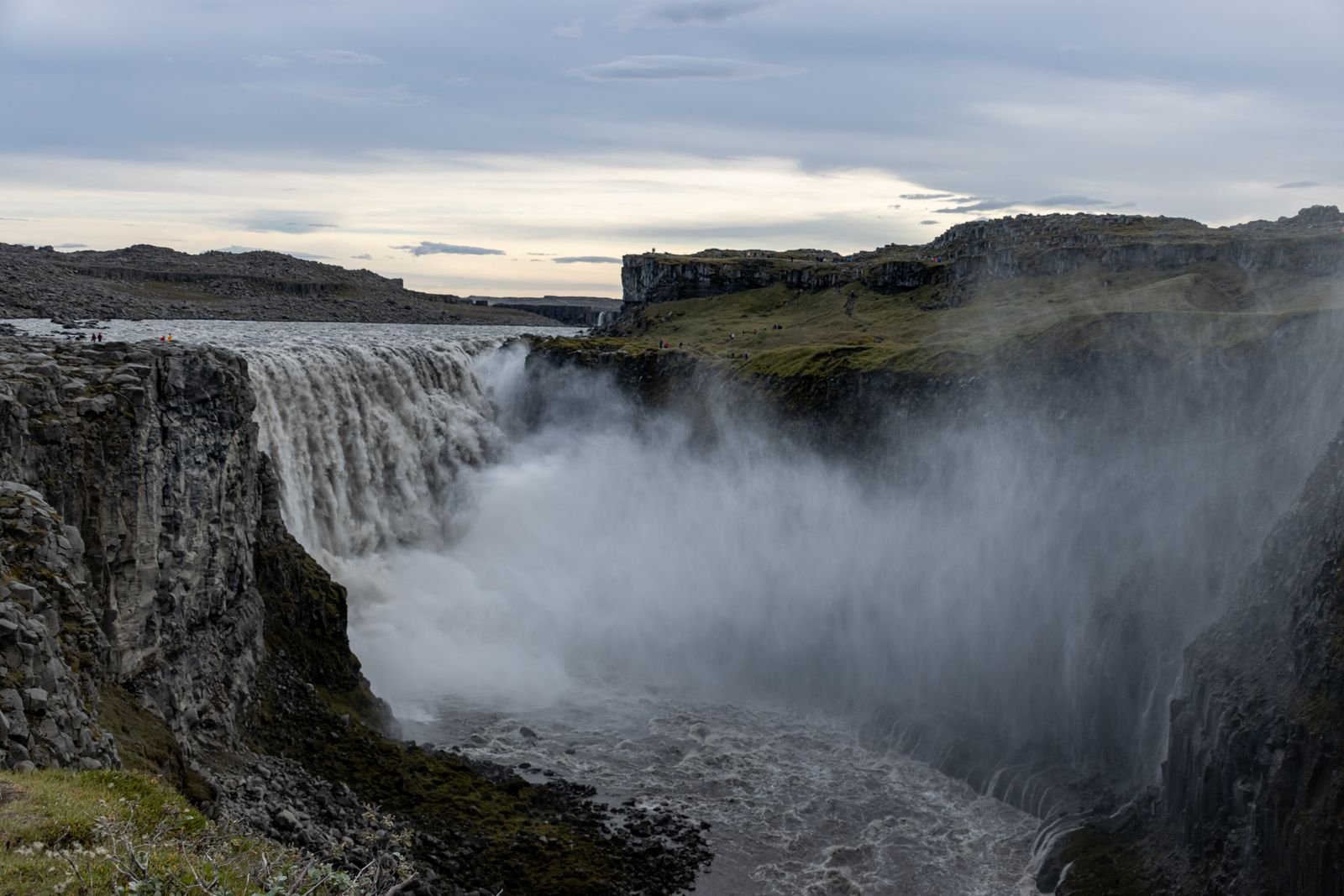
Dettifoss is not the prettiest waterfall in Iceland. It is not the tallest, and it is not the one that appears on the most postcards. What Dettifoss is, by the measure that matters most, is the most powerful waterfall in Europe. The water of the Jökulsá á Fjöllum river, fed by the Vatnajökull glacier, falls 44 metres over a cliff 100 metres wide, at a rate that can reach 500 cubic metres per second in summer. The sound is a deep, rolling thunder, the spray rises in a grey cloud, and the ground seems to shake beneath your feet. Dettifoss, in north-east Iceland, is a waterfall that you feel as much as you see, and this guide explains how to visit it, what to expect, and how to make the most of the wild landscape around it.
Dettifoss sits in Vatnajökull National Park, in the Jökulsárgljúfur canyon, one of the longest river canyons in Iceland. The river that feeds it is grey with glacial silt, and the canyon walls are dark basalt, broken into columns and cliffs. The landscape around Dettifoss is stark and volcanic, with little of the green softness of the south coast. It is a place that feels ancient and elemental, and it is also a place that is easy to reach, with roads on both sides of the river, a short walk to the falls, and a series of other sights within a short drive. For many visitors, Dettifoss is the highlight of a trip to the north of Iceland, and it is a waterfall that stays with you long after you have left.
The Power of Dettifoss
To understand Dettifoss, you need to understand the river. The Jökulsá á Fjöllum is the second longest river in Iceland, and it begins at the Vatnajökull ice cap, the largest glacier in Europe. As the glacier melts, the water carries silt and sand, and it flows north through the highlands, carving the Jökulsárgljúfur canyon. At Dettifoss, the river drops over a cliff of basalt, and the force of the water is extraordinary. The average flow is about 200 cubic metres per second, and in summer, when the glacier is melting fastest, it can be more than twice that. The waterfall is 44 metres high and 100 metres wide, and the combination of height, width and volume makes it the most powerful waterfall in Europe.
The power of Dettifoss is not just a number. Stand at the viewpoint, and you will feel the spray on your face, hear the roar in your chest, and see the river below churning in a grey, violent pool. The basalt columns on either side of the falls are dark and wet, and the rainbow that forms in the spray on a sunny day is a brief, bright contrast to the grey water. Dettifoss is a waterfall that rewards patience. Stay for a while, watch the light change, and listen to the sound. It is a place that is best experienced slowly, not as a quick stop on a tour.
East Bank or West Bank: Which Side to Visit?
Dettifoss can be visited from both sides of the river, and the two sides offer different experiences. The west bank, reached by road 862, is the more popular side, because the road is paved, the car park is close to the falls, and the viewpoint is directly in front of the waterfall. The walk from the car park is about a kilometre, on a flat, well-marked path, and it takes about fifteen minutes. The west bank viewpoint is the best place to see the full width of Dettifoss, and it is also the best place to feel its power, because the spray drifts across the viewpoint.
The east bank, reached by road 864, is a gravel road, and it is rougher and slower, but it offers a different view. From the east bank, you see Dettifoss from the side, and you can walk along the canyon edge to a viewpoint that looks down the river. The east bank is quieter, and it is also the side from which you can walk to Selfoss, the waterfall upstream, which is smaller and more graceful than Dettifoss. If you have time, visit both sides. The west bank is best for the classic view, and the east bank is best for the canyon, the walk to Selfoss and the sense of the landscape. If you have to choose one, choose the west bank in summer, when the road is good, and the east bank in winter, when the west bank road is closed.
Selfoss and Hafragilsfoss: The Neighbours of Dettifoss
Dettifoss is not the only waterfall in the Jökulsárgljúfur canyon. A short walk upstream, about a kilometre from Dettifoss, is Selfoss, a wide, low waterfall that spreads across the river in a series of small falls. Selfoss is quieter and more graceful than Dettifoss, and it is a good place to sit and rest after the power of Dettifoss. The walk to Selfoss is flat and easy, and it is well worth the extra half hour. Downstream from Dettifoss, about two kilometres away, is Hafragilsfoss, a waterfall that drops 27 metres into the canyon. Hafragilsfoss is less visited, because it requires a drive on a rough road and a short walk, but it is a fine waterfall in its own right, and the view down the canyon from the viewpoint is one of the best in the area.
Together, Dettifoss, Selfoss and Hafragilsfoss make the Jökulsárgljúfur canyon one of the great waterfall landscapes in Iceland. The canyon itself is worth exploring, with its basalt columns, its dark cliffs and its river that is grey with glacial silt. The area is also a good place to see birds, including the gyrfalcon, the largest falcon in the world, which nests in the cliffs. Bring binoculars if you are interested in birds, and take your time. The canyon rewards the traveller who walks, rather than the one who drives from viewpoint to viewpoint.
Dettifoss and the Diamond Circle
Dettifoss is one of the main sights on the Diamond Circle, the driving route in north-east Iceland that also includes Lake Mývatn, the town of Húsavík, the Ásbyrgi canyon and the Hljóðaklettar rock formations. The Diamond Circle is a full day’s drive, or a leisurely two days, and it is one of the best road trips in Iceland, because it combines waterfalls, lakes, volcanoes, birdlife and whale watching. Lake Mývatn, with its pseudo-craters, its hot springs and its birdlife, is the natural base for the Diamond Circle, and Húsavík, the whale watching capital of Iceland, is the natural end point.
If you are driving the Diamond Circle, plan to spend at least half a day at Dettifoss and the Jökulsárgljúfur canyon, and allow time for Selfoss and Hafragilsfoss. The roads in the area are good in summer, but they can be rough in winter, and the east bank road is gravel all year. Check the road conditions before you go, because the weather in north-east Iceland can change quickly, and the roads can be closed by snow or by flooding. The Diamond Circle is a route that is best enjoyed slowly, with time to stop, to walk and to look, rather than as a race from one sight to the next.
When to Visit Dettifoss
The best time to visit Dettifoss is in summer, from June to September, when the roads are open, the days are long and the waterfall is at its most powerful. The flow of the river is highest in summer, when the glacier is melting, and the spray is at its most dramatic. The weather is also at its best in summer, though it can still be cold and windy, and you should be prepared for rain. The midnight sun in June and July means that you can visit Dettifoss late in the evening, when the crowds have gone and the light is soft, and that is one of the best times to see the falls.
Winter in the north-east of Iceland is a different experience. The roads to Dettifoss can be closed by snow, and the west bank road is usually closed in winter, but the east bank road is sometimes open, and the waterfall, partially frozen and surrounded by snow, is a sight that few people see. If you visit in winter, go with a guide or with a four-wheel-drive vehicle, check the road conditions, and be prepared for very cold weather. Spring and autumn are quieter, with fewer visitors, but the weather can be changeable, and the roads can be wet and slippery. Whatever the season, Dettifoss is a waterfall that is worth the journey.
Getting to Dettifoss
Dettifoss is reached by road from the town of Egilsstaðir, in the east, or from Akureyri, in the north, or from Lake Mývatn, which is the closest base. From Mývatn, the drive to Dettifoss takes about an hour, on the Ring Road and then on road 862 to the west bank, or road 864 to the east bank. From Egilsstaðir, the drive takes about two hours, and from Akureyri, about two and a half hours. There is no public transport to Dettifoss, so you will need a car, or a tour from Mývatn or Akureyri. Tours from Mývatn are a good option if you do not want to drive, and they often include the other sights of the Diamond Circle.
The roads to Dettifoss are good in summer, but they can be rough in winter, and the east bank road is gravel. A normal car is fine in summer, but a four-wheel-drive is recommended in winter, and in any season, check the road conditions on the Icelandic road website before you set out. For a wider sense of how waterfalls are visited in other parts of the world, our guide to Niagara Falls shows a very different kind of waterfall, wide and urban, while Victoria Falls in Africa offers a waterfall that is both wide and powerful. More background on Dettifoss is available on Wikipedia’s Dettifoss page.
Practical Tips for Visiting Dettifoss
A few practical tips will make your visit to Dettifoss safer and more enjoyable. Wear waterproof clothing, because the spray from the falls will soak you, even from the viewpoint, and the wind can carry the spray a long way. Wear proper walking shoes, because the paths can be wet and slippery, and the rocks near the falls are smooth and treacherous. Stay behind the barriers and the marked paths, because the canyon edge is dangerous, and people have died at Dettifoss. Do not climb on the rocks near the falls, and do not try to get closer to the water than the viewpoint allows.
Bring food and water, because there are no shops or restaurants at Dettifoss, and the nearest town is Mývatn, an hour away. Bring a camera, but protect it from the spray, and bring a lens cloth, because the spray will cover the lens in seconds. Take your time, and stay for a while, because Dettifoss is a waterfall that rewards patience. The light changes, the spray moves, and the sound is constant. It is a place to sit and listen, as much as a place to photograph.
Frequently Asked Questions
Is Dettifoss the most powerful waterfall in Europe?
Yes, by volume of water, Dettifoss is the most powerful waterfall in Europe. The river flows at an average of about 200 cubic metres per second, and in summer it can reach 500 cubic metres per second. The waterfall is 44 metres high and 100 metres wide.
How long does it take to visit Dettifoss?
Allow at least an hour, and preferably two. The walk from the car park takes about fifteen minutes each way, and you will want time at the viewpoint. If you also walk to Selfoss, allow another hour, and if you visit both banks, allow half a day.
Can you visit Dettifoss in winter?
Yes, but it is more difficult. The west bank road is usually closed in winter, and the east bank road can be closed by snow. Go with a four-wheel-drive vehicle or a tour, check the road conditions, and be prepared for very cold weather.
Is there an entrance fee for Dettifoss?
There is no entrance fee, but there is a parking fee at the car parks on both banks. The fee helps to maintain the paths and the facilities in Vatnajökull National Park.
What is the best side of Dettifoss to visit?
The west bank offers the best frontal view and the easiest access, while the east bank offers a quieter experience, a view along the canyon and a walk to Selfoss. If you have time, visit both sides.
Conclusion
Dettifoss is a waterfall that does not need to be the prettiest or the tallest to be unforgettable. Its power, its sound and its grey, volcanic landscape make it one of the most impressive natural sights in Iceland, and one of the most powerful waterfalls in Europe. Visit it from both banks if you can, walk to Selfoss, and take time to listen to the river. Dettifoss is a place that reminds you how small you are, and how powerful nature can be, and it is a place that you will remember long after you have left Iceland.