
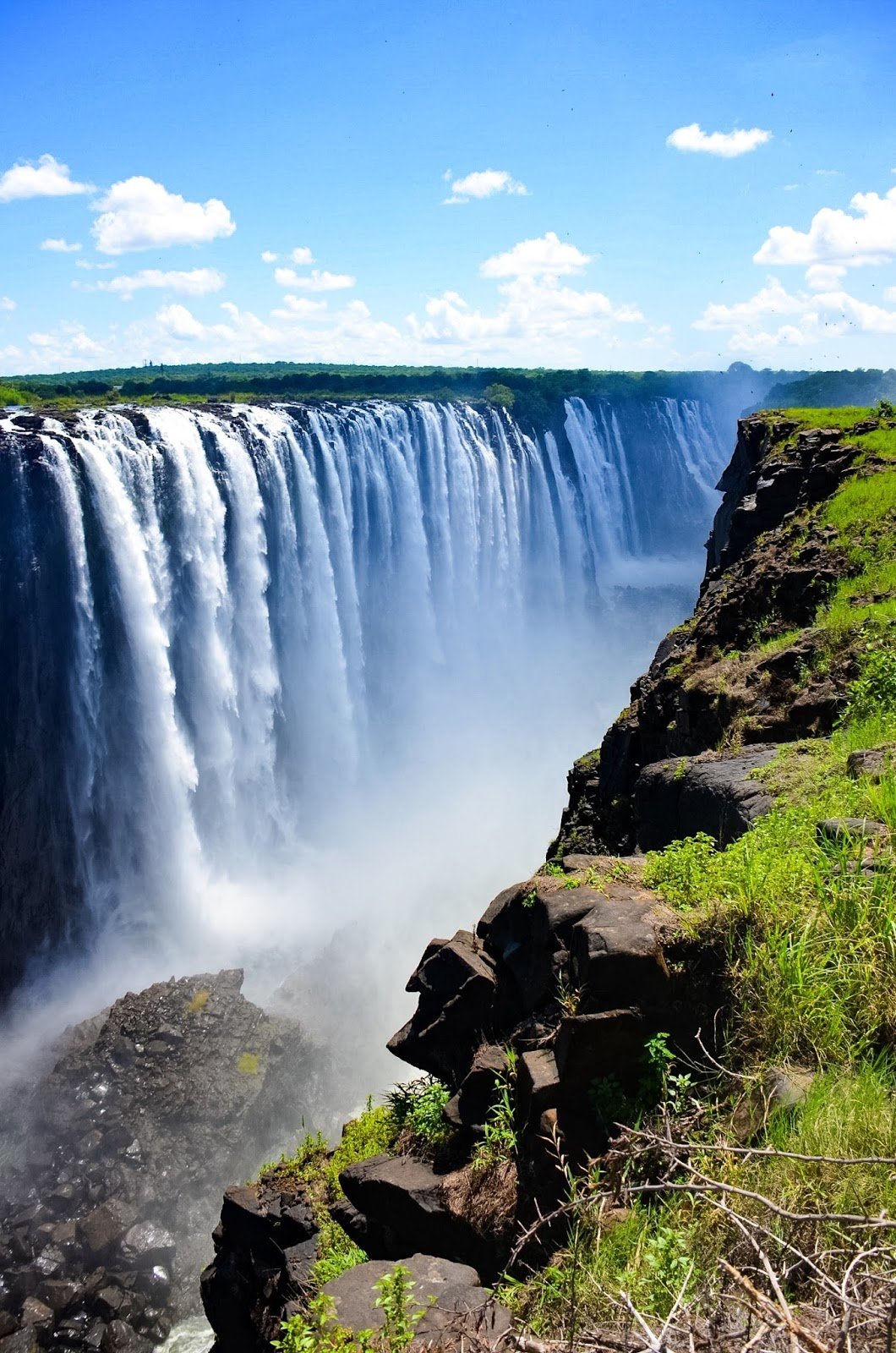
Victoria Falls: The Majestic Natural Wonder of Africa
Introduction
Victoria Falls is one of the most spectacular natural wonders in the world. Located on the Zambezi River along the border between Zambia and Zimbabwe, this enormous waterfall is famous for its incredible width, powerful water flow, dramatic cliffs, misty atmosphere, and surrounding African landscapes. Known locally as Mosi-oa-Tunya, meaning “The Smoke That Thunders,” Victoria Falls is much more than a waterfall. It is a remarkable combination of water, rock, forest, wildlife, history, culture, and adventure.
The sight of millions of liters of water rushing over the edge of a massive basalt gorge is unforgettable. When the Zambezi River is flowing strongly, clouds of mist rise high above the waterfall and can be seen from a considerable distance. Sunlight passing through the mist can create beautiful rainbows, making the landscape even more extraordinary.
Victoria Falls attracts travelers from around the world who come to experience its viewpoints, walking trails, wildlife, river activities, scenic flights, adventure sports, and unique African environment. It is also an important natural and cultural landmark for Zambia and Zimbabwe.
This article explores the history, geography, geology, wildlife, tourism, attractions, activities, best times to visit, travel tips, conservation efforts, and fascinating facts about Victoria Falls.
1. What Is Victoria Falls?
Victoria Falls is a giant waterfall created by the Zambezi River as it drops into a series of deep gorges. The waterfall stretches for roughly 1.7 kilometers across the river and reaches a height of approximately 108 meters at its highest point.
Although Victoria Falls is not the tallest waterfall on Earth, its combination of height and enormous width makes it one of the world’s most impressive waterfalls. During periods of high water, the amount of water moving over the falls creates a huge curtain of spray and mist.
The waterfall has two famous names. The English name, Victoria Falls, became widely known after the Scottish explorer David Livingstone encountered the waterfall in the nineteenth century. The local name, Mosi-oa-Tunya, reflects the dramatic sound and appearance of the waterfall.
The phrase “Smoke That Thunders” is especially appropriate. From a distance, the rising mist can resemble smoke, while the roar of the water can be remarkably loud.
Victoria Falls is divided between Zambia and Zimbabwe. Both countries offer different viewpoints and experiences, allowing visitors to appreciate different sides of this extraordinary natural landmark.
2. Where Is Victoria Falls Located?
Victoria Falls is situated in southern Africa on the Zambezi River. The river forms part of the border between Zambia and Zimbabwe before plunging over the waterfall.
On the Zimbabwean side, the main tourist town is Victoria Falls. On the Zambian side, the nearby city is Livingstone.
The location is particularly interesting because the waterfall and its surrounding landscapes connect two countries while forming part of a larger African ecosystem.
The Zambezi River is one of Africa’s major rivers. It travels through several landscapes before reaching Victoria Falls. The river’s journey eventually continues toward the Indian Ocean.
The waterfall itself is surrounded by protected natural areas. Forests, river habitats, islands, cliffs, and nearby wildlife areas make the region attractive not only for waterfall sightseeing but also for nature tourism.
3. The Local Name: Mosi-oa-Tunya
One of the most fascinating aspects of Victoria Falls is its traditional name.
The waterfall is known as Mosi-oa-Tunya, which is commonly translated as “The Smoke That Thunders.”
The name describes two of its most obvious characteristics.
The “smoke” refers to the enormous clouds of spray created when the Zambezi River crashes into the gorge below. The “thunder” refers to the powerful sound created by the falling water.
For local communities, the waterfall has long been an important natural and cultural feature. Its significance goes beyond tourism and photography.
Understanding the traditional name also helps visitors appreciate that the waterfall existed as a major landmark long before it became famous internationally.
4. The History of Victoria Falls
Victoria Falls has a long history connected with the people who lived around the Zambezi River.
Local communities knew about the waterfall for generations. Its location, river environment, and surrounding lands were part of the region’s cultural landscape.
The waterfall became particularly well known internationally in the nineteenth century when Scottish missionary and explorer David Livingstone reached it.
Livingstone is generally credited with becoming the first European to document the waterfall in detail during his 1855 expedition along the Zambezi River.
According to historical accounts, Livingstone approached the falls from an island now associated with his name. He was deeply impressed by the enormous curtain of water.
The waterfall was subsequently named Victoria Falls in honor of Queen Victoria of Britain.
Over time, the falls became increasingly known outside Africa. Exploration, trade, railway development, and tourism helped transform the region into an international destination.
The construction of transportation infrastructure made it easier for travelers to reach the waterfall. Tourism eventually became an important part of the local economy.
Today, Victoria Falls remains both a historical landmark and a major tourist attraction.
5. David Livingstone and Victoria Falls
David Livingstone is one of the best-known historical figures associated with Victoria Falls.
Livingstone traveled extensively through southern and central Africa during the nineteenth century. His journeys were motivated by exploration, missionary interests, and geographical discovery.
When he reached the Zambezi River and encountered the waterfall, he recognized its extraordinary significance.
Livingstone’s writings and reports helped introduce Victoria Falls to a wider international audience.
A small island near the falls is known as Livingstone Island. Today, the island can be visited under controlled conditions, depending on river levels and local tour arrangements.
The connection between Livingstone and the waterfall remains an important part of the area’s tourism history.
6. The Geography of Victoria Falls
Victoria Falls is located on a broad section of the Zambezi River.
Before reaching the waterfall, the river flows across relatively wide terrain. It then suddenly encounters a dramatic geological formation that forces the water into a narrow gorge.
The falls are not simply one straight drop. Instead, the water moves across several sections and plunges into a deep canyon.
The main waterfall sections include areas commonly known as Devil’s Cataract, Main Falls, Rainbow Falls, and Horseshoe Falls, with the precise appearance changing depending on seasonal water levels.
The geography of the area is one of the reasons Victoria Falls is so visually impressive.
The river, cliffs, islands, rainforest, gorges, and spray combine to create a landscape that feels completely different from the surrounding dry savanna.
7. How Victoria Falls Was Formed
Victoria Falls exists because of the interaction between the Zambezi River and the region’s underlying basalt rock.
Basalt is a volcanic rock formed from ancient lava flows. Over geological periods, cracks and fractures developed within the rock.
The Zambezi River gradually exploited these weaknesses.
Water erosion slowly enlarged cracks and channels in the basalt. Over extremely long periods, sections of the riverbed were worn away, creating deep gorges.
The waterfall is therefore not a static feature. Geological processes continue to influence the landscape.
The gorge below the waterfall shows evidence of the river’s long-term erosion. The zigzag shape of the downstream gorges provides clues about how the waterfall has gradually moved through the landscape over geological time.
This makes Victoria Falls not only beautiful but also scientifically fascinating.
8. The Size of Victoria Falls
Victoria Falls is remarkable because of its combination of height and width.
The waterfall extends for approximately 1.7 kilometers along the Zambezi River.
Its highest drop is around 108 meters.
The amount of water passing over the falls changes significantly throughout the year. During the rainy season, the Zambezi can become extremely powerful, producing huge volumes of water and massive amounts of spray.
During the dry season, some sections may become less powerful, allowing visitors to see more of the underlying rock formations.
The changing water levels mean that Victoria Falls can look very different depending on when someone visits.
9. The Zambezi River
The Zambezi River is essential to the existence of Victoria Falls.
It is one of the major rivers of Africa and supports communities, ecosystems, wildlife, agriculture, tourism, and hydroelectric power systems along its course.
The river begins in northwestern Zambia and travels across a large part of southern Africa.
Before reaching Victoria Falls, the Zambezi passes through various landscapes and ecosystems.
At Victoria Falls, the river dramatically changes elevation, creating the waterfall.
After passing through the gorges, the river continues eastward through several regions before eventually reaching the Indian Ocean.
The relationship between the river and waterfall demonstrates the enormous power of flowing water over geological time.
10. Victoria Falls and the Surrounding Rainforest
One of the most surprising features around Victoria Falls is the rainforest environment.
The surrounding rainforest exists largely because of the constant spray generated by the waterfall.
Water vapor and mist provide moisture to the vegetation, creating a relatively lush environment close to the falls.
Visitors can walk through paths surrounded by green plants, trees, vines, and other vegetation.
The contrast is remarkable.
Just beyond the waterfall area, the broader region can be much drier, while the area receiving constant spray remains green and humid.
This creates a unique microenvironment.
11. Wildlife Around Victoria Falls
Victoria Falls is located within a region that supports diverse African wildlife.
Animals found in the wider area can include elephants, hippos, crocodiles, buffalo, giraffes, zebras, antelopes, warthogs, baboons, monkeys, and numerous bird species.
The Zambezi River provides water and habitat for many animals.
Elephants are particularly famous in the wider Victoria Falls region. Visitors may encounter them during safari excursions or while traveling through nearby wildlife areas.
Hippos and crocodiles are commonly associated with the river environment, although visitors should never approach wild animals or enter potentially dangerous water areas without professional guidance.
The wildlife experience is one of the reasons many travelers combine a Victoria Falls visit with a safari.
12. Birds at Victoria Falls
The Victoria Falls region is also excellent for birdwatching.
The river, woodland, rainforest, cliffs, and surrounding habitats support many bird species.
Visitors may encounter colorful birds, water birds, raptors, and smaller woodland species.
Birdwatching can be especially enjoyable during quieter walks away from the busiest viewpoints.
Early mornings are often particularly rewarding for wildlife observation because temperatures are cooler and many animals and birds are active.
For serious birdwatchers, bringing binoculars and a field guide can greatly improve the experience.
13. Victoria Falls National Park
On the Zimbabwean side, Victoria Falls is protected within Victoria Falls National Park.
The park provides access to a series of viewpoints overlooking different parts of the waterfall.
Walking through the park allows visitors to experience the changing perspectives of the falls.
Some viewpoints provide wide views across the main waterfall, while others allow visitors to see the powerful water plunging into the gorge.
The park also protects the rainforest environment created by the waterfall’s spray.
Visitors should follow marked trails and local safety instructions.
14. Mosi-oa-Tunya National Park
On the Zambian side, Mosi-oa-Tunya National Park protects an important natural area near Livingstone and the Zambezi River.
The park is known for wildlife and scenic landscapes.
One of its notable attractions is its population of white rhinoceroses, which are protected through conservation programs.
The park offers opportunities for visitors to experience both wildlife and the natural environment around Victoria Falls.
Combining a visit to the waterfall with a wildlife excursion can create a more complete African travel experience.
15. The Best Viewpoints of Victoria Falls
One of the best ways to experience Victoria Falls is by visiting multiple viewpoints.
Each viewpoint reveals a different part of the waterfall.
Some areas offer dramatic views of the main curtain of water. Others focus on the deep gorge or the swirling spray.
On the Zimbabwean side, visitors can explore a number of established viewpoints within the national park.
The Zambian side provides a different perspective and can offer opportunities to see the waterfall from another angle.
Because water levels change during the year, the appearance of individual viewpoints can also change.
16. Devil’s Cataract
Devil’s Cataract is one of the sections of Victoria Falls.
It is located near the western end of the waterfall on the Zimbabwean side.
This area can provide impressive views of powerful water movement and the deep gorge.
The appearance of Devil’s Cataract varies with the season.
During periods of high water, spray can make visibility difficult, while lower water levels may reveal more rock detail.
17. Main Falls
The Main Falls are among the most spectacular parts of Victoria Falls.
During high-flow periods, enormous quantities of water move over the edge, creating an almost continuous wall of water.
The resulting spray can rise dramatically into the air.
Standing near the viewpoints during high water can feel like experiencing a powerful natural storm.
Water droplets cover the surrounding vegetation and visitors, creating the famous rainforest atmosphere.
18. Rainbow Falls
Rainbow Falls is named for the rainbows frequently visible in the mist.
When sunlight interacts with suspended water droplets, light is refracted and reflected, creating colorful arcs.
The waterfall’s spray can make rainbow viewing particularly spectacular.
Under suitable conditions, visitors may see vivid rainbows from different viewpoints.
The combination of moving water, mist, sunlight, and rainbows makes this area particularly popular with photographers.
19. Horseshoe Falls
Horseshoe Falls is another section of the waterfall.
Its curved shape contributes to the distinctive appearance of the waterfall.
Water levels strongly influence the amount of water visible across different sections.
During the high-water season, the entire waterfall can appear extremely powerful, while lower water levels may expose more of the rock formations.
20. Victoria Falls Bridge
The Victoria Falls Bridge is another famous landmark in the area.
The bridge crosses the Zambezi River gorge between Zambia and Zimbabwe.
It was constructed during the early twentieth century and became an important transportation link in the region.
Today, the bridge is also associated with tourism and adventure activities.
Visitors can admire views of the gorge and waterfall area from the bridge.
The structure itself has become part of the visual identity of Victoria Falls.
21. Walking Around Victoria Falls
Walking is one of the simplest and most rewarding ways to explore Victoria Falls.
The established trails allow visitors to move between viewpoints while experiencing different aspects of the landscape.
During high-water periods, visitors should expect to get wet.
Rain jackets, waterproof bags, and protective covers for cameras and phones can be useful.
Comfortable walking shoes are also recommended because the paths can become wet and slippery.
Walking slowly and stopping at different viewpoints allows travelers to appreciate the waterfall rather than rushing through the experience.
22. The Sound of Victoria Falls
The sound of Victoria Falls is one of its defining characteristics.
Large volumes of water crash into the gorge continuously, creating a deep and powerful roar.
The sound changes depending on water levels and viewing location.
From a distance, the waterfall may sound like distant thunder.
Closer to the main viewpoints, the noise can become overwhelming.
This is one reason the local name “Smoke That Thunders” is so appropriate.
23. The Mist of Victoria Falls
The mist created by Victoria Falls is almost as famous as the waterfall itself.
When water crashes into the gorge, millions of droplets are thrown into the air.
Wind carries the mist across surrounding areas.
During high-water periods, the mist can become so intense that visitors may struggle to see the falls clearly from some viewpoints.
The spray also supports the lush vegetation surrounding the waterfall.
24. Rainbows at Victoria Falls
Rainbows are among the most beautiful natural features associated with Victoria Falls.
They are produced when sunlight interacts with water droplets in the mist.
The best conditions usually occur when sunlight and spray combine at suitable angles.
Visitors often see bright rainbows near the waterfall.
In certain conditions, moonlight can also interact with the mist to create a lunar rainbow, commonly called a moonbow.
This phenomenon is one of the most fascinating experiences associated with Victoria Falls.
25. Best Time to Visit Victoria Falls
The best time to visit Victoria Falls depends on what a traveler wants to experience.
During the high-water season, the waterfall is at its most powerful.
Visitors who want to see enormous volumes of water and dramatic spray may prefer the high-flow period.
However, heavy spray can sometimes make photography and visibility difficult.
During lower-water periods, more of the underlying rock formations may be visible.
This can provide clearer views of the gorge and individual waterfall sections.
Therefore, there is no single perfect month for everyone.
The ideal season depends on whether the priority is maximum water flow, clearer views, wildlife, adventure activities, or photography.
26. Visiting During the Rainy Season
The rainy season is important because rainfall in the Zambezi basin influences river levels.
As water levels increase, Victoria Falls becomes increasingly powerful.
The spray can be enormous.
Visitors during this period should prepare for wet conditions.
Waterproof clothing can make the experience much more comfortable.
Cameras and electronic devices should also be protected from moisture.
27. Visiting During the Dry Season
During the dry season, water levels can become significantly lower.
Some sections of the waterfall may become less active.
However, lower water levels can provide clearer views of the geological structure.
This can be particularly useful for photographers, geology enthusiasts, and travelers who want to see details hidden by heavy spray.
The dry season may also provide good opportunities for other activities in the surrounding region.
28. Things to Do at Victoria Falls
Victoria Falls offers much more than sightseeing.
Popular activities include:
- Walking around the waterfall viewpoints
- Boat trips on the Zambezi River
- Sunset cruises
- Wildlife safaris
- Scenic helicopter flights
- Microlight flights
- Bungee jumping
- Gorge activities
- Fishing
- Photography
- Birdwatching
- Visiting Livingstone Island
- Exploring local cultural attractions
The region is suitable for both relaxed travelers and adventure seekers.
29. Zambezi River Cruises
A sunset cruise on the Zambezi River is a popular experience.
These cruises provide an opportunity to see the river in a calmer environment away from the roar of the waterfall.
Depending on the location and conditions, travelers may see hippos, crocodiles, birds, elephants, and other wildlife along the riverbanks.
Sunset can create beautiful colors across the water and surrounding landscape.
River cruises are generally much more peaceful than adventure activities around the waterfall.
30. Wildlife Safari
A Victoria Falls trip can easily be combined with a safari.
The surrounding region contains several wildlife areas and national parks.
Safari travelers may encounter elephants, buffalo, giraffes, zebras, antelopes, lions, and other African wildlife depending on the destination and season.
A safari adds another dimension to a waterfall holiday.
Instead of experiencing only water and landscape, travelers can explore the broader African ecosystem.
31. Helicopter Flights Over Victoria Falls
Aerial flights are one of the best ways to understand the scale of Victoria Falls.
From the air, visitors can see the full width of the waterfall, the Zambezi River, surrounding forests, and the deep gorges.
The aerial perspective also reveals the geological shape of the landscape.
For photographers, aerial views can produce extraordinary images.
Flight availability depends on weather, regulations, and local operators.
32. Microlight Flights
For travelers seeking a more adventurous aerial experience, microlight flights may be available.
These flights provide an open-air perspective of the waterfall and surrounding landscape.
The experience can feel very different from a helicopter flight.
As with any adventure activity, travelers should use reputable operators and follow all safety instructions.
33. Bungee Jumping
Victoria Falls is famous among adventure travelers for bungee jumping from the Victoria Falls Bridge.
The jump provides an extraordinary view of the Zambezi River gorge.
It is an activity designed for people who enjoy extreme adventure.
Travelers should carefully check operator safety standards, equipment procedures, weather restrictions, age requirements, and medical considerations before participating.
34. Whitewater Rafting
The Zambezi below Victoria Falls is known for dramatic rapids.
Whitewater rafting is therefore one of the region’s most famous adventure activities.
The rapids can be extremely powerful, and rafting conditions vary depending on river levels.
Professional guides, safety equipment, and appropriate experience are essential.
This activity is generally more suitable for adventure-oriented travelers than families seeking a relaxed sightseeing experience.
35. Livingstone Island
Livingstone Island is located near the edge of Victoria Falls.
The island became historically associated with David Livingstone’s visit.
Today, guided excursions can allow visitors to experience the island and view the waterfall from a unique location.
Access depends heavily on river conditions and safety considerations.
The experience can be particularly memorable because visitors are positioned close to the waterfall’s edge.
36. Devil’s Pool
Devil’s Pool is one of the most famous attractions associated with Victoria Falls.
It is a naturally formed pool near the edge of the waterfall on the Zambian side.
During suitable low-water conditions, guided visits may allow people to enter the pool.
Because the location is extremely close to the waterfall’s edge, it is not an ordinary swimming destination.
Access should only be undertaken through authorized professional guides and when conditions are officially considered safe.
River conditions can change quickly, so visitors should never attempt to reach the area independently.
37. Photography at Victoria Falls
Victoria Falls is an extraordinary destination for photographers.
There are countless opportunities to photograph:
- The waterfall
- Rainbows
- Mist
- Zambezi River
- Wildlife
- Sunsets
- Forests
- Bridges
- Gorges
- Adventure activities
- Local culture
A waterproof camera cover or protective bag is particularly useful near the waterfall.
A wide-angle lens can help capture the scale of the falls.
Early morning and late afternoon light can also create attractive photographic conditions.
38. Victoria Falls for Nature Lovers
Nature lovers can spend several days exploring the region.
The waterfall itself provides one experience, while nearby forests, rivers, parks, and wildlife areas provide others.
Visitors can observe how water shapes the landscape and how the spray supports a special rainforest ecosystem.
The region demonstrates the close relationship between geological processes and biological life.
39. Victoria Falls for Families
Families can enjoy Victoria Falls, although activities should be selected according to children’s ages and safety requirements.
Walking through the waterfall viewpoints can be an exciting experience for children.
Wildlife trips and boat cruises may also be enjoyable.
Adventure activities such as bungee jumping and certain rafting experiences are generally restricted by age and safety requirements.
Families should plan their itinerary around safe, age-appropriate activities.
40. Victoria Falls for Adventure Travelers
Adventure travelers are particularly attracted to the area.
The region offers a combination of:
- Bungee jumping
- Whitewater rafting
- Gorge activities
- Scenic flights
- Canoeing
- Wildlife adventures
- Hiking
- Fishing
- River cruises
Few destinations combine such a spectacular waterfall with so many adventure opportunities.
41. Local Culture
The communities around Victoria Falls have rich cultural traditions.
Travelers can learn about local music, dance, crafts, food, history, and traditional lifestyles.
Visiting cultural attractions respectfully can help tourists understand the region beyond its natural beauty.
Local markets can also provide opportunities to purchase handmade crafts and souvenirs.
Responsible tourism means respecting local customs, asking permission before photographing people, and supporting legitimate local businesses.
42. Food Around Victoria Falls
Visitors can experience a mixture of African and international cuisine in the Victoria Falls and Livingstone areas.
Local dishes may include maize-based foods, vegetables, meat, fish, and regional specialties.
Because the area receives international tourists, many restaurants also serve familiar international meals.
Trying local food can be an enjoyable part of the journey.
Travelers should also drink safe water and follow normal food-safety practices.
43. Accommodation
The Victoria Falls region offers many accommodation options.
Travelers can choose from:
- Luxury lodges
- Hotels
- Safari lodges
- Guesthouses
- Budget accommodations
- Camps
- Boutique properties
Luxury lodges often emphasize river views, wildlife experiences, spa facilities, and premium dining.
Budget accommodations can provide more affordable access to the waterfall and nearby activities.
The best choice depends on budget, travel style, and preferred location.
44. How Long Should You Stay?
A short visit of two or three days can cover the major waterfall viewpoints.
However, travelers who want to combine the falls with wildlife, river activities, cultural experiences, and adventure sports may benefit from staying longer.
A four- to five-day trip can provide more time for different activities.
Travelers combining Victoria Falls with a larger southern African itinerary may stay several days before continuing to another destination.
45. Zambia Side vs. Zimbabwe Side
Both sides of Victoria Falls offer unique experiences.
The Zimbabwean side is famous for its extensive series of viewpoints.
The Zambian side offers different perspectives and provides access to attractions such as Livingstone Island and, under suitable conditions, Devil’s Pool.
Rather than thinking of one side as universally better, travelers can consider visiting both if their schedule allows.
Cross-border travel requirements should always be checked before planning to visit both countries.
46. Safety at Victoria Falls
Victoria Falls is a powerful natural environment.
Visitors should take safety seriously.
Important precautions include:
- Stay on designated paths.
- Follow park instructions.
- Do not climb barriers.
- Never approach wildlife.
- Do not swim in unauthorized areas.
- Follow guides during adventure activities.
- Protect valuables from water.
- Pay attention to changing weather.
- Keep children close to adults.
- Follow local warnings about river conditions.
The waterfall is beautiful but extremely powerful.
Respecting the environment is essential.
47. Conservation of Victoria Falls
Protecting Victoria Falls is important for both environmental and economic reasons.
The waterfall supports tourism, which provides employment and income for communities in Zambia and Zimbabwe.
Conservation efforts focus on protecting the waterfall, river, surrounding forests, wildlife, and cultural heritage.
Sustainable tourism is increasingly important.
Visitors can help by avoiding litter, respecting wildlife, using water responsibly, supporting local businesses, and following park regulations.
48. Climate Change and Victoria Falls
Like many major natural environments, Victoria Falls is influenced by changing climate patterns.
Rainfall levels affect the Zambezi River, and therefore water levels at the waterfall.
Changes in rainfall timing, drought conditions, and temperature patterns can influence the river ecosystem.
This does not mean that the waterfall will simply disappear, but it demonstrates why long-term environmental monitoring and sustainable water management are important.
The future of Victoria Falls depends partly on protecting the wider Zambezi River system.
49. Why Victoria Falls Is a World-Famous Natural Wonder
Victoria Falls is famous for several reasons.
First, its enormous width creates an impressive curtain of water.
Second, its height produces tremendous energy as the river falls into the gorge.
Third, the surrounding mist creates a unique rainforest environment.
Fourth, the waterfall is connected with the Zambezi River and a much larger African ecosystem.
Finally, its combination of natural beauty, history, wildlife, culture, and adventure makes it different from many other waterfalls.
50. Interesting Facts About Victoria Falls
Here are some fascinating facts about Victoria Falls:
- Victoria Falls is located on the Zambezi River.
- It lies between Zambia and Zimbabwe.
- Its traditional name is Mosi-oa-Tunya.
- Mosi-oa-Tunya means “The Smoke That Thunders.”
- The waterfall is approximately 1.7 kilometers wide.
- Its highest drop is about 108 meters.
- David Livingstone visited the falls in the nineteenth century.
- The falls were named Victoria Falls in honor of Queen Victoria.
- The waterfall creates enormous amounts of mist.
- Rainbows are common around the falls.
- Lunar rainbows can sometimes occur.
- The surrounding rainforest is supported by waterfall spray.
- Victoria Falls Bridge connects Zambia and Zimbabwe.
- The area is famous for wildlife.
- The Zambezi River supports many species.
- Adventure activities are popular in the region.
- Helicopter flights provide spectacular aerial views.
- The waterfall’s appearance changes with seasonal water levels.
- Victoria Falls is part of a UNESCO-recognized natural heritage area.
- It is one of Africa’s most famous tourist attractions.
51. Why You Should Visit Victoria Falls
There are many reasons to add Victoria Falls to a travel bucket list.
The waterfall itself is unforgettable.
The roar of the water, the mist in the air, the rainbows above the gorge, and the surrounding African landscape create an experience that photographs cannot fully reproduce.
Visitors can also combine sightseeing with wildlife safaris, river cruises, adventure sports, cultural activities, and scenic flights.
This makes Victoria Falls suitable for many different types of travelers.
Whether someone loves nature, photography, adventure, history, wildlife, or relaxation, the region offers something memorable.
52. Tips for First-Time Visitors
First-time visitors can make their trip easier by preparing in advance.
Wear comfortable shoes because walking between viewpoints can take time.
Carry waterproof protection for electronic equipment.
Bring sunscreen and insect protection.
Drink enough water, especially during warm weather.
Plan outdoor activities around local weather conditions.
If you want to participate in adventure activities, book through reputable operators.
If possible, allow enough time to experience both the waterfall and surrounding attractions.
Most importantly, respect the natural environment.
53. Victoria Falls as a Photography Destination
For photographers, Victoria Falls is a dream destination.
The waterfall offers different appearances throughout the day and year.
Morning light can create soft atmospheric conditions.
Midday sunlight can produce bright rainbows.
Late afternoon can provide warmer tones.
Wildlife and river photography can complement waterfall photography.
A waterproof camera bag is highly recommended because the spray can be intense.
Visitors should also remember that protecting equipment is less important than personal safety.
54. The Emotional Experience of Seeing Victoria Falls
Seeing Victoria Falls for the first time can be an emotional experience.
The sheer scale of the waterfall can make people feel very small compared with the power of nature.
The combination of sound, movement, mist, and landscape creates a sensory experience that is difficult to reproduce elsewhere.
Many visitors remember not only what they saw but also what they heard and felt.
That is one reason Victoria Falls continues to attract travelers from every part of the world.
55. Victoria Falls and Sustainable Tourism
Tourism can provide important economic benefits to communities near Victoria Falls.
Hotels, restaurants, guides, transportation companies, tour operators, craftspeople, and wildlife organizations all participate in the tourism economy.
Responsible visitors can contribute positively by choosing local businesses and respecting the environment.
Sustainable tourism also means reducing unnecessary waste and avoiding activities that harm wildlife.
The goal is to ensure that future generations can experience the same natural wonder.
56. A Suggested Victoria Falls Itinerary
A three-day itinerary could look like this:
Day 1: Explore the Waterfall
Spend the first day visiting the main viewpoints.
Walk through the rainforest and experience the mist.
Take plenty of photographs and enjoy the different sections of the falls.
Day 2: Zambezi River and Wildlife
Take a river cruise or wildlife excursion.
Spend time observing birds and animals.
A sunset cruise can be a relaxing way to finish the day.
Day 3: Adventure and Culture
Choose an activity such as a scenic flight, rafting, or another guided adventure.
Later, explore local markets and cultural attractions.
This itinerary can be adjusted depending on season, budget, and personal interests.
57. Best Experiences for Different Travelers
For Photographers
Focus on viewpoints, rainbows, mist, aerial flights, and wildlife.
For Families
Choose waterfall walks, wildlife viewing, and river cruises.
For Adventure Seekers
Consider rafting, bungee jumping, gorge activities, and aerial adventures.
For Nature Lovers
Explore the waterfall rainforest, river environment, wildlife areas, and bird habitats.
For History Lovers
Learn about the local communities, David Livingstone, the bridge, and the development of tourism.
58. What Makes Victoria Falls Different?
Many waterfalls around the world are impressive.
Victoria Falls stands out because it combines several extraordinary features.
It is wide.
It is tall.
It is powerful.
It produces enormous spray.
It supports a rainforest.
It sits on a major African river.
It is surrounded by wildlife.
It connects two countries.
It offers numerous adventure activities.
It has a fascinating cultural and exploration history.
Together, these qualities make Victoria Falls one of the world’s most recognizable natural landmarks.
59. The Future of Victoria Falls
The future of Victoria Falls depends on responsible environmental management.
Protecting the Zambezi River and surrounding ecosystems is essential.
Tourism must be managed carefully to prevent environmental damage.
Wildlife conservation also remains important.
Climate variability makes long-term monitoring increasingly valuable.
With careful management, Victoria Falls can continue attracting visitors while maintaining its ecological and cultural importance.
60. Conclusion
Victoria Falls is one of the most extraordinary natural landmarks in Africa and one of the world’s great waterfall destinations.
Located on the Zambezi River between Zambia and Zimbabwe, the falls combine enormous scale, geological beauty, powerful water, misty rainforests, wildlife, history, culture, and adventure.
Its traditional name, Mosi-oa-Tunya — “The Smoke That Thunders” — perfectly captures the experience.
The waterfall is not simply something to look at. It is something to hear, feel, and experience.
The roar of the Zambezi, the clouds of spray, the sight of rainbows in the mist, the deep basalt gorge, and the surrounding African landscape create a destination that remains unforgettable.
Visitors can explore the waterfall on foot, take a river cruise, watch wildlife, experience adventure sports, fly above the falls, explore local culture, and discover the geological story written into the surrounding rocks.
Victoria Falls also reminds us of the importance of protecting natural environments. Its beauty depends on the Zambezi River, surrounding ecosystems, wildlife, forests, and careful conservation.
For anyone interested in natural wonders, Africa, wildlife, photography, adventure, or unforgettable travel experiences, Victoria Falls deserves a place high on the list.
It is a destination where the power of nature can be seen and heard at its greatest.
Frequently Asked Questions About Victoria Falls
1. Where is Victoria Falls located?
Victoria Falls is located on the Zambezi River along the border between Zambia and Zimbabwe.
2. What is the local name for Victoria Falls?
The traditional name is Mosi-oa-Tunya, commonly translated as “The Smoke That Thunders.”
3. How high is Victoria Falls?
The highest drop of Victoria Falls is approximately 108 meters.
4. How wide is Victoria Falls?
The waterfall extends for approximately 1.7 kilometers along the Zambezi River.
5. Who discovered Victoria Falls?
Local communities knew the waterfall long before European exploration. David Livingstone became famous for documenting it during his 1855 journey.
6. Why is Victoria Falls called the Smoke That Thunders?
The name describes the mist that rises from the waterfall and the powerful roar created by falling water.
7. Can you visit Victoria Falls from both countries?
Yes. Visitors can experience the waterfall from both Zambia and Zimbabwe, subject to border and entry requirements.
8. What is the best time to visit Victoria Falls?
The best time depends on what you want to see. High-water periods provide powerful flows and heavy spray, while lower-water periods can provide clearer views of the rock formations.
9. Can you swim at Victoria Falls?
Swimming is not generally safe around the waterfall. Certain guided experiences, such as Devil’s Pool during appropriate low-water conditions, may be available under professional supervision.
10. What animals can be seen near Victoria Falls?
The wider region supports elephants, hippos, crocodiles, buffalo, giraffes, zebras, antelopes, monkeys, birds, and many other species.
11. Is Victoria Falls worth visiting?
Yes. Its combination of spectacular scenery, wildlife, adventure, culture, and history makes it one of Africa’s most memorable destinations.
12. How many days are enough for Victoria Falls?
Two or three days can cover the major attractions, while four or five days provide more time for wildlife, river activities, adventure, and cultural experiences.
13. Can you see rainbows at Victoria Falls?
Yes. Rainbows are frequently visible when sunlight passes through the waterfall’s mist.
14. Can you see a moonbow at Victoria Falls?
Under suitable conditions, a lunar rainbow or moonbow can occur when moonlight interacts with the waterfall’s mist.
15. What should I bring to Victoria Falls?
Comfortable walking shoes, sunscreen, drinking water, insect protection, and waterproof protection for electronics are useful items.
Final Thoughts
Victoria Falls represents the incredible power of nature.
From the enormous Zambezi River to the mist-covered rainforest and deep basalt gorges, every part of the landscape tells a story.
A visit to Victoria Falls is therefore more than a sightseeing trip. It is an opportunity to experience one of Earth’s most impressive natural processes and to discover the wildlife, culture, history, and landscapes of southern Africa.
For travelers searching for a destination that combines beauty, adventure, wildlife, and unforgettable scenery, Victoria Falls remains one of the world’s greatest natural wonders.


4 Comments