Patagonia: A Complete Guide to One of the World’s Most Beautiful Natural Regions
Introduction
Patagonia is one of the most extraordinary natural regions on Earth. Located at the southern end of South America, Patagonia stretches across parts of Argentina and Chile and is famous for its dramatic mountains, enormous glaciers, turquoise lakes, windswept plains, ancient forests, fjords, rivers, and spectacular wildlife. It is a destination where nature appears on a truly immense scale.
For travelers who love mountains, hiking, photography, wildlife, adventure, and untouched landscapes, Patagonia offers an unforgettable experience. The region contains some of the most recognizable natural landmarks in South America, including the granite peaks of the Andes, the glaciers of southern Argentina and Chile, and the spectacular landscapes of national parks such as Torres del Paine and Los Glaciares.
Patagonia is not a single city or a single park. Instead, it is a vast geographical and cultural region covering an enormous area. Its landscapes change dramatically from place to place. In some areas, visitors encounter dry grasslands and open plains. In others, there are dense forests, snow-covered mountains, deep valleys, giant ice fields, and coastal fjords.
One of the most fascinating things about Patagonia is its sense of wilderness. Even in places that attract thousands of visitors, the surrounding landscapes can feel remote and untouched. The combination of dramatic scenery, challenging weather, and vast open spaces gives Patagonia a special character that is difficult to find elsewhere.
This article explores the geography, history, climate, wildlife, landscapes, national parks, attractions, outdoor activities, culture, travel considerations, and environmental importance of Patagonia.
Where Is Patagonia?
Patagonia is located in the southern portion of South America. It occupies large areas of both Argentina and Chile.
The region generally extends southward from approximately the area of the Río Colorado in Argentina and reaches toward the southern tip of the continent. Its exact boundaries can vary depending on geographical definitions.
The Andes Mountains form a major part of the natural landscape and, in many areas, create a dramatic division between Argentina and Chile.
On the Argentine side, Patagonia includes extensive steppe landscapes, mountain ranges, lakes, glaciers, and famous destinations such as El Calafate, El Chaltén, Bariloche, and the Valdés Peninsula.
On the Chilean side, Patagonia contains spectacular fjords, mountains, forests, islands, glaciers, and national parks. Puerto Natales and Punta Arenas are important gateways to many southern attractions.
Because Patagonia covers such a large area, it is impossible to understand it through a single landscape. It is better imagined as a collection of different environments connected by mountains, rivers, forests, plains, and ice.
The Geography of Patagonia
Patagonia has an extraordinary variety of geographical features.
The Andes are among the most important elements of the region. These mountains contain numerous peaks, valleys, glaciers, and lakes. Some mountains rise dramatically from relatively flat surroundings, creating spectacular views.
The western portion of Patagonia is generally wetter, especially on the Chilean side. Moisture from the Pacific Ocean encounters the Andes, producing substantial precipitation in some areas.
The eastern side, particularly in Argentina, is often much drier. Here, extensive grasslands and shrub-covered steppe dominate the landscape.
This geographical contrast is one of Patagonia’s defining characteristics.
Visitors can travel from humid forests and glacier-covered mountains to dry plains within relatively short distances.
The region also contains enormous ice systems. The Southern Patagonian Ice Field is one of the largest expanses of ice outside the polar regions. Numerous glaciers flow from these ice fields into valleys and lakes.
The Andes Mountains in Patagonia
The Andes Mountains are the backbone of much of Patagonia.
These mountains are famous for their dramatic appearance. Sharp peaks, rocky cliffs, snow-covered summits, and deep valleys create some of the most impressive mountain scenery in the world.
Many famous Patagonian destinations are associated with the Andes.
One of the best-known examples is the Fitz Roy massif near El Chaltén in Argentina. The distinctive granite peaks rise dramatically above surrounding valleys and are a major attraction for hikers and photographers.
On the Chilean side, the mountains of Torres del Paine are equally famous. The three granite towers for which the national park is named create one of the most recognizable mountain scenes in Patagonia.
The Andes also influence Patagonia’s climate, vegetation, rivers, and glaciers.
For travelers, they provide countless opportunities for hiking, climbing, trekking, camping, and photography.
Patagonia’s Famous Glaciers
Glaciers are among the most spectacular natural features of Patagonia.
These enormous bodies of ancient ice have shaped valleys and landscapes for thousands of years. Some glaciers continue to move slowly through mountain valleys, while others are retreating because of changing climate conditions.
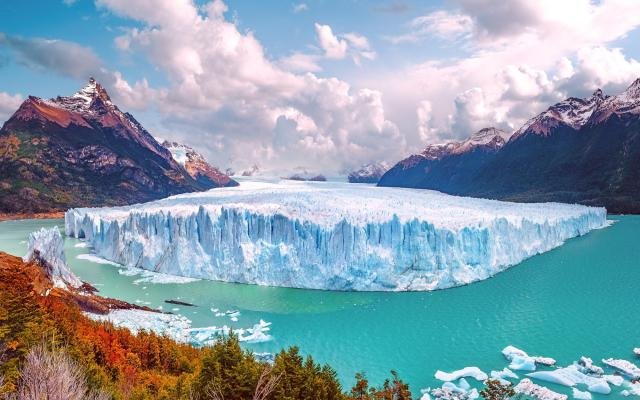
One of the most famous is Perito Moreno Glacier in Argentina.
Perito Moreno is located within Los Glaciares National Park and is famous for its enormous ice wall. Visitors can observe the glacier from viewing platforms or experience boat excursions that approach the glacier from the water.
One of the most dramatic natural events associated with Perito Moreno is ice calving. Huge pieces of ice can break away from the glacier and crash into the surrounding water, producing a powerful sound and spectacular sight.
Other important glaciers are found throughout southern Chile and Argentina.
The glaciers of Patagonia are not simply tourist attractions. They are important components of regional ecosystems and freshwater systems. They also provide scientists with valuable information about climate and environmental change.
Torres del Paine National Park
Torres del Paine National Park is one of Patagonia’s most famous natural destinations.
Located in southern Chile, the park is known for its mountains, glaciers, lakes, rivers, forests, grasslands, and wildlife.
The three granite towers are the park’s most iconic feature.
The park is especially popular among hikers and trekkers. Several trails pass through different environments, allowing visitors to experience forests, valleys, mountain viewpoints, and glacial landscapes.
One of the best-known trekking routes is the W Trek. Another major route is the longer O Circuit.
The scenery changes dramatically throughout the park. A single journey can include blue lakes, snow-covered mountains, hanging glaciers, ancient forests, and wide valleys.
Torres del Paine is also an important wildlife habitat. Visitors may encounter guanacos, foxes, birds, and, with luck, elusive pumas.
Because weather conditions can change quickly, visitors need to prepare carefully before hiking in the park.
Los Glaciares National Park
Los Glaciares National Park is located in Argentina and is another major highlight of Patagonia.
The park is famous for its glaciers, mountains, lakes, and spectacular landscapes.
It is home to Perito Moreno Glacier and also provides access to the mountains around El Chaltén.
The park’s huge scale makes it particularly impressive.
Visitors can explore glaciers by boat, walk along designated viewpoints, hike through mountain valleys, or join guided glacier excursions.
The park demonstrates the incredible power of ice. Glaciers have carved valleys, shaped mountains, and influenced the region’s lakes and rivers.
El Chaltén: Argentina’s Trekking Capital
El Chaltén is a small mountain town in Argentine Patagonia that has become famous among hikers and outdoor enthusiasts.
The town is located near the Fitz Roy massif and provides access to numerous hiking trails.
Some trails are relatively easy, while others require greater physical preparation.
One of the most famous viewpoints is Laguna de los Tres, which provides spectacular views toward Mount Fitz Roy.
Another popular destination is Laguna Torre, where visitors can see Mount Torre and surrounding glacial landscapes.
El Chaltén has a relaxed atmosphere compared with larger tourist destinations. Many visitors come primarily for hiking and spend several days exploring the surrounding trails.
The town demonstrates how Patagonia combines adventure tourism with small communities surrounded by wilderness.
El Calafate and Lake Argentino
El Calafate is one of the principal tourist gateways to southern Argentine Patagonia.
The town sits near Lago Argentino, a large glacial lake surrounded by impressive landscapes.
It is particularly popular because of its access to Los Glaciares National Park and Perito Moreno Glacier.
El Calafate also offers restaurants, hotels, tour companies, museums, and transportation services.
Many travelers use the town as a base for exploring glaciers and surrounding natural attractions.
The landscape around El Calafate is a mixture of open steppe, mountains, lakes, and distant ice-covered peaks.
The area also provides opportunities for boat trips, hiking, horseback riding, wildlife observation, and scenic excursions.
Patagonia’s Lakes
Patagonia contains many beautiful lakes.
Some are fed by glaciers and have striking blue or turquoise colors. The unusual colors often result from fine particles of rock, sometimes called glacial flour, suspended in the water.
Among the famous lakes are Lago Argentino, Lago Nahuel Huapi, Lago General Carrera, and Lago Grey.
The lakes are surrounded by mountains, forests, glaciers, or grasslands depending on their location.
Lake Nahuel Huapi is associated with the popular city of Bariloche in northern Patagonia. The region is known for mountain scenery, forests, water sports, hiking, and winter activities.
Farther south, glacial lakes provide dramatic views of the Andes.
For photographers, Patagonian lakes can be especially beautiful during sunrise and sunset, when changing light reflects off the water and mountains.
Bariloche and Northern Patagonia
San Carlos de Bariloche is one of the most popular destinations in northern Patagonia.
The city is located beside Lake Nahuel Huapi and is surrounded by mountains and forests.
Unlike the remote southern areas of Patagonia, Bariloche has a more developed tourism infrastructure.
Visitors can enjoy hiking, kayaking, skiing, sightseeing, cycling, and scenic drives.
During winter, the nearby mountains become popular destinations for snow sports.
The city is also known for its architecture, food, chocolate, and views of the surrounding landscapes.
Bariloche demonstrates the diversity of Patagonia because the region is not exclusively about remote trekking. It can also offer comfortable tourism, cultural experiences, food, and family-friendly activities.
The Patagonian Steppe
When many people imagine Patagonia, they picture enormous mountains and glaciers. However, another important landscape is the Patagonian steppe.
The steppe covers large portions of eastern Patagonia, particularly in Argentina.
It is characterized by open spaces, grasses, shrubs, rocky terrain, and a relatively dry climate.
At first glance, the landscape may appear simple. However, the steppe supports a surprising variety of wildlife.
Guanacos are particularly common in some areas. These wild relatives of llamas and alpacas can often be seen moving across the plains.
The steppe also provides habitat for foxes, armadillos, rheas, birds of prey, and other species.
The vastness of the steppe gives Patagonia another defining characteristic: space.
Visitors can sometimes travel long distances without encountering major settlements, creating a powerful sense of isolation.
Wildlife of Patagonia
Patagonia supports an impressive variety of wildlife.
The region’s different ecosystems provide habitats for mammals, birds, marine animals, and countless smaller species.
One of the most famous animals is the guanaco.
Guanacos are adapted to the harsh Patagonian environment and can survive in dry grasslands and mountainous areas.
The puma is another important species.
Pumas are elusive predators and are difficult to spot. However, Patagonia has become one of the world’s notable destinations for people interested in observing these animals in the wild.
Foxes are also found throughout parts of the region.
Birdlife is equally impressive. Condors can sometimes be seen soaring over mountains and valleys.
Other birds include rheas, flamingos, geese, ducks, hawks, and numerous smaller species.
Along Patagonia’s coastlines, visitors can encounter penguins, sea lions, elephant seals, whales, and other marine wildlife.
The Patagonian Puma
The puma is one of Patagonia’s most iconic predators.
These large cats are powerful, adaptable, and highly elusive.
Patagonia’s combination of open landscapes and protected areas can provide opportunities to observe them, particularly in regions where conservation efforts have helped maintain healthy populations.
Seeing a puma in the wild is often considered one of the most memorable experiences available to wildlife enthusiasts.
However, visitors should always maintain a safe distance and follow local regulations.
Wild animals should never be approached, fed, or disturbed for photographs.
The survival of pumas depends on healthy ecosystems, adequate prey, and protection from human conflict.
Penguins in Patagonia
Penguins are another major attraction.
Several penguin species inhabit southern South America.
One of the best-known locations is Punta Tombo in Argentina, which supports a major colony of Magellanic penguins.
During the breeding season, large numbers of penguins can gather along the coast.
Visitors may observe them walking between nesting areas and the sea.
Penguin colonies provide a fascinating opportunity to observe animal behavior, including nesting, feeding, and caring for young.
Responsible tourism is particularly important around penguin colonies because human disturbance can affect breeding animals.
Whales and Marine Wildlife
Patagonia’s coastline is rich in marine life.
The Valdés Peninsula in Argentina is one of the best-known wildlife areas.
Southern right whales visit the region during part of the year to breed and raise their young.
The peninsula is also associated with sea lions, elephant seals, penguins, seabirds, and other marine species.
Whale watching can be an unforgettable experience.
Seeing a large whale surface near a boat or from the coastline provides a powerful reminder of the scale and diversity of marine ecosystems.
Marine conservation is essential to protecting these animals and maintaining Patagonia’s ecological balance.
The Valdés Peninsula
The Valdés Peninsula is a UNESCO World Heritage Site and one of Argentina’s most important wildlife destinations.
The peninsula contains beaches, cliffs, coastal plains, and protected habitats.
It is particularly famous for marine mammals.
Southern right whales visit the surrounding waters, while elephant seals and sea lions occupy parts of the coastline.
The area also supports large populations of seabirds and penguins.
Unlike the high mountains of southern Patagonia, the Valdés Peninsula provides a completely different experience.
It demonstrates that Patagonia is not only a mountain destination. Its coastal environments are equally important.
Patagonia’s Forests
Western Patagonia contains beautiful forests.
These forests are especially common in wetter areas of Chile and along parts of the Andes.
Species of southern beech are important components of many Patagonian forests.
The forests change color throughout the year. During autumn, some areas become particularly beautiful as leaves turn golden, orange, and red.
Forests provide habitat for birds, mammals, insects, and countless plants.
They also protect soils, regulate water systems, and help maintain regional biodiversity.
Hiking through a Patagonian forest can feel completely different from walking across the open steppe or beside a glacier.
The Climate of Patagonia
Patagonia is famous for its unpredictable weather.
Strong winds are common, particularly in exposed areas.
Temperatures can also change rapidly.
A day that begins with sunshine can become cloudy, rainy, or cold within a short period.
Mountain areas can experience snow even outside the traditional winter season.
The western side of the Andes is generally wetter, while many eastern areas are considerably drier.
Because weather is so variable, travelers should prepare for multiple conditions.
Good outdoor clothing, waterproof layers, sun protection, sturdy footwear, and extra clothing are valuable.
The famous Patagonian wind is not simply a tourist story. It can be a serious environmental factor and may make hiking more challenging.
Best Time to Visit Patagonia
The best time to visit Patagonia depends on the activities you want to enjoy.
The warmer months of the Southern Hemisphere are generally the most popular period for hiking and outdoor tourism.
December, January, and February are summer months in Patagonia and usually provide longer daylight hours.
Spring and autumn can offer beautiful landscapes and fewer visitors in some areas, although weather conditions may be more unpredictable.
Winter brings shorter days and colder conditions.
However, some destinations become attractive for skiing and other winter activities.
Travelers should research their specific destination because Patagonia covers such a large area that conditions can vary considerably.
Hiking in Patagonia
Hiking is one of the main reasons people travel to Patagonia.
The region offers trails for different levels of experience.
Some routes are short and accessible, while others require several days of trekking.
Popular hiking areas include Torres del Paine, El Chaltén, Bariloche, and many smaller protected areas.
A typical Patagonian hike may pass through several landscapes in a single day.
You might begin in a forest, cross open grassland, walk beside a river, and eventually reach a mountain viewpoint.
Long-distance trekking requires careful preparation.
Travelers should consider weather forecasts, trail conditions, water availability, food, navigation, physical fitness, and emergency planning.
Trekking in Torres del Paine
Torres del Paine is particularly famous for multi-day trekking.
The W Trek is one of the most recognized routes in the park.
It connects several major scenic areas and allows hikers to experience glaciers, mountains, valleys, forests, and lakes.
The O Circuit provides a longer journey around the park’s central mountain region.
Trekkers may stay in designated campsites or refugios depending on regulations and availability.
Reservations and park rules can be important, especially during busy periods.
Weather conditions can also change rapidly, so flexibility is essential.
Mount Fitz Roy
Mount Fitz Roy is one of Patagonia’s most recognizable mountains.
Located near El Chaltén, the mountain is known for its steep granite formations and dramatic silhouette.
The Fitz Roy area attracts hikers, climbers, photographers, and nature lovers.
The mountain can look completely different depending on weather and lighting.
Sometimes clouds surround the summit, creating a mysterious atmosphere. At other times, clear skies reveal the entire massif.
The hike to Laguna de los Tres is one of the area’s most famous routes.
The final approach can be challenging, but the views are highly rewarding.
Mount Torre
Mount Torre is another famous Patagonian peak.
Its sharp granite summit and surrounding glaciers create a dramatic landscape.
The trail to Laguna Torre is popular among hikers visiting El Chaltén.
The route passes through forests and valleys before reaching the lagoon.
Weather can strongly influence the experience.
On a clear day, the mountain may appear in full view. On a cloudy day, only parts of the peak may be visible.
Both situations can be beautiful in different ways.
Adventure Activities in Patagonia
Patagonia offers much more than traditional hiking.
Visitors can participate in activities such as:
- Trekking
- Mountain climbing
- Rock climbing
- Kayaking
- Horseback riding
- Glacier hiking
- Boat excursions
- Fishing
- Cycling
- Wildlife watching
- Skiing
- Photography
- Camping
The variety of activities makes Patagonia suitable for different types of travelers.
Some people visit for extreme adventures, while others prefer scenic drives, boat trips, photography, and short walks.
Glacier Hiking
Glacier hiking is one of Patagonia’s most unusual experiences.
Specialized guides lead visitors onto certain glaciers using appropriate safety equipment.
Walking across ancient ice allows travelers to see crevasses, ice formations, streams, and unusual textures.
Glacier environments can be dangerous without proper training and equipment.
For this reason, glacier trekking should be done with reputable professional guides.
The experience also provides an opportunity to understand how glaciers function and how sensitive they are to environmental change.
Kayaking and Water Adventures
Patagonia’s lakes and rivers provide excellent opportunities for kayaking.
Paddling through clear glacial waters with mountains in the background can be an unforgettable experience.
Some locations also offer kayaking near glaciers.
However, cold water creates significant risks.
Even during warm weather, glacial lakes can be extremely cold.
Visitors should use proper safety equipment and follow local guidance.
Horseback Riding in Patagonia
Horseback riding has strong historical connections with Patagonian culture.
The traditional figure of the gaucho is closely associated with life in Argentina’s rural regions.
Horseback tours can provide a different way to explore the landscape.
Riding across open grasslands, valleys, and mountain areas can give visitors a sense of how people historically traveled through these remote environments.
It can also provide access to areas that are difficult to reach by vehicle.
The Gaucho Culture
The gaucho is an important cultural symbol of Argentina.
Gauchos traditionally worked with cattle and horses across rural landscapes.
In Patagonia, rural traditions remain visible in certain areas.
Visitors may encounter ranches known as estancias, where livestock farming continues to play an important role.
Some estancias welcome tourists and provide opportunities to learn about rural life, horseback riding, traditional food, and local history.
The gaucho tradition adds a cultural dimension to a journey that might otherwise focus entirely on natural landscapes.
Patagonian Estancias
Estancias are large rural properties found in parts of Patagonia.
Historically, sheep farming became an important industry in the region.
Today, some estancias continue agricultural activities while also offering tourism experiences.
Visitors can learn about ranching, traditional food, horseback riding, and the history of settlement.
Staying at an estancia can provide a quieter and more cultural experience than staying in a busy tourist town.
It also helps visitors understand how people adapted to Patagonia’s remote and challenging environment.
Patagonia’s Rivers
Rivers are essential components of Patagonia’s ecosystems.
Many rivers originate in mountains and glaciers before flowing toward lakes, plains, and oceans.
The combination of snow, glaciers, rainfall, and mountain runoff feeds numerous waterways.
Some rivers are popular for fishing, rafting, kayaking, and other outdoor activities.
Rivers also provide freshwater for wildlife and human communities.
Changes in glacier size and snow patterns can influence river systems, making them important subjects for environmental research.
Patagonia and Climate Change
Climate change is one of the most important environmental issues facing Patagonia.
Glaciers across the region have experienced significant changes.
Some glaciers are retreating, although the behavior of individual glaciers varies.
Changing temperatures, precipitation patterns, wind conditions, and snow accumulation can influence glacier health.
Because glaciers store enormous amounts of freshwater, their changes can affect ecosystems and human communities.
Climate change also creates challenges for wildlife and vegetation.
Protecting Patagonia requires cooperation among governments, scientists, conservation organizations, local communities, tourism operators, and visitors.
Conservation in Patagonia
Patagonia contains many protected areas.
National parks and reserves help protect mountains, forests, glaciers, grasslands, wetlands, and wildlife.
Conservation is particularly important because tourism is increasing in popularity.
Tourism can provide economic benefits to local communities, but unmanaged tourism can also create environmental pressure.
Responsible visitors should stay on designated trails, dispose of waste properly, avoid disturbing wildlife, respect camping rules, and follow protected-area regulations.
Small actions by individual travelers can contribute to long-term conservation.
Responsible Tourism in Patagonia
Responsible tourism is essential when visiting fragile natural environments.
Visitors should avoid leaving trash behind.
They should remain on marked trails where required and avoid damaging plants.
Wild animals should never be fed.
Campfires should only be made where permitted.
Tourists should also respect local communities and cultural traditions.
Choosing local guides, accommodation providers, restaurants, and businesses can help ensure that tourism benefits local communities.
Patagonia’s beauty is one of its greatest assets, and protecting that beauty is a shared responsibility.
Photography in Patagonia
Patagonia is a dream destination for photographers.
Almost every part of the region offers dramatic photographic opportunities.
Mountains, glaciers, lakes, forests, wildlife, clouds, and open plains can create extraordinary compositions.
Sunrise and sunset are particularly attractive because soft light can transform mountains and glaciers.
However, Patagonia’s weather can also create excellent photography opportunities.
Clouds and fog can add atmosphere to mountain scenes.
Wildlife photography requires patience.
Photographers should maintain appropriate distances and never disturb animals for a better photograph.
Why Patagonia Is So Special
Patagonia is special because of its extraordinary combination of scale, diversity, and wilderness.
Few destinations offer such a wide range of landscapes within one broad region.
A traveler can experience:
- Huge mountains
- Ancient forests
- Massive glaciers
- Turquoise lakes
- Dry grasslands
- Coastal cliffs
- Penguins
- Whales
- Guanacos
- Pumas
- Remote valleys
- Deep fjords
- Vast open skies
The region also offers a powerful feeling of distance from modern urban life.
In many places, there are no large buildings, heavy traffic, or dense populations.
Instead, visitors encounter wind, mountains, rivers, animals, and enormous open spaces.
How to Travel Around Patagonia
Because Patagonia is so large, transportation planning is important.
Major towns serve as gateways to different regions.
On the Argentine side, places such as Bariloche, El Calafate, and El Chaltén are popular bases.
On the Chilean side, Puerto Natales and Punta Arenas are important gateways.
Long-distance buses connect many destinations.
Domestic flights can save time when traveling between distant parts of the region.
Rental cars are useful in some areas, particularly for travelers who want flexibility.
However, roads can be long and conditions may vary.
Travelers should plan distances carefully rather than assuming destinations are close together.
Accommodation in Patagonia
Accommodation options range from luxury hotels to hostels, lodges, campsites, refugios, guesthouses, and rural estancias.
In popular destinations, accommodation can become limited during peak travel periods.
Hikers planning multi-day treks should research campsite and refugio requirements in advance.
Some protected areas have strict rules about where visitors can stay overnight.
Luxury lodges can provide comfortable bases for wildlife viewing and scenic exploration.
Budget travelers can often find hostels and simple guesthouses in major tourist towns.
Food in Patagonia
Patagonian cuisine reflects both local ingredients and broader Argentine and Chilean traditions.
Argentina is famous for beef and traditional barbecue known as asado.
Lamb is particularly associated with Patagonia.
Seafood is important in coastal areas.
Visitors may also encounter trout, local cheeses, breads, berries, and regional desserts.
In towns such as Bariloche, chocolate is particularly famous.
Food can be an important part of understanding the region because it reflects agriculture, geography, and cultural traditions.
Safety in Patagonia
Patagonia is generally an attractive destination for outdoor travelers, but nature itself can present risks.
Weather is one of the most important factors.
Strong winds, sudden rain, snow, cold temperatures, and poor visibility can occur.
Hikers should always check local conditions before starting a trail.
Proper clothing and equipment are essential.
Visitors should also carry sufficient water and food for longer routes.
Navigation skills can be important in remote areas.
It is wise to tell someone about your hiking plans when traveling independently.
Following park regulations and local guidance can significantly reduce risks.
What to Pack for Patagonia
Packing depends on the season and destination, but useful items may include:
- Waterproof jacket
- Warm layers
- Hiking shoes
- Comfortable socks
- Hat and gloves
- Sun protection
- Sunglasses
- Sunscreen
- Reusable water bottle
- Backpack
- First-aid supplies
- Headlamp
- Navigation equipment
- Portable power bank
- Weather-resistant clothing
Layering is particularly useful because temperatures can change throughout the day.
Good footwear is essential for hiking.
Travelers should also avoid overpacking because some journeys involve frequent transportation between destinations.
Patagonia for Families
Although Patagonia is famous for challenging trekking, families can also enjoy the region.
Many destinations offer short walks, boat excursions, wildlife viewing, scenic drives, and accessible viewpoints.
Families can visit glaciers, observe penguins, explore lakes, and enjoy mountain scenery without undertaking difficult multi-day hikes.
The key is choosing activities appropriate for children’s ages and abilities.
Weather preparation is particularly important when traveling with children.
Patagonia for Adventure Travelers
For adventure travelers, Patagonia is one of the world’s great destinations.
The region offers challenging hikes, mountaineering, climbing, glacier trekking, kayaking, horseback riding, and remote expeditions.
Experienced climbers can explore demanding mountain environments.
Long-distance trekkers can spend multiple days in protected wilderness.
Adventure travel in Patagonia requires preparation and respect for nature.
The environment can be demanding even for experienced outdoor enthusiasts.
Patagonia for Nature Lovers
Nature lovers can spend weeks exploring Patagonia without running out of places to visit.
Wildlife watching is a major attraction.
Birdwatchers can search for condors and other species.
Marine enthusiasts can observe whales, penguins, sea lions, and elephant seals.
Botany enthusiasts can explore forests and steppe vegetation.
Geology enthusiasts can study mountains, glaciers, valleys, and rock formations.
The region provides opportunities to experience nature at almost every level.
Patagonia for Photographers
Photographers can find endless inspiration in Patagonia.
Mountain landscapes are obvious subjects, but the region offers much more.
Photographers can capture wildlife, forests, rivers, clouds, rural life, glaciers, and local communities.
The changing weather means the same landscape can look completely different from one hour to another.
Patagonia’s long summer daylight can also provide extended opportunities for photography.
A good photographer should be prepared to wait.
Some of the most memorable scenes happen when sunlight briefly breaks through clouds and illuminates a mountain or glacier.
The Spirit of Patagonia
Beyond its physical beauty, Patagonia has a distinctive spirit.
It represents remoteness, exploration, independence, and wilderness.
The region has attracted explorers, scientists, climbers, photographers, writers, and adventurers for generations.
Its huge landscapes encourage visitors to slow down and appreciate natural surroundings.
For many travelers, Patagonia becomes more than a vacation destination.
It becomes a personal experience of distance, silence, challenge, and discovery.
Famous Places to Visit in Patagonia
Some of the most famous destinations include:
- Torres del Paine National Park
- Los Glaciares National Park
- Perito Moreno Glacier
- El Chaltén
- Mount Fitz Roy
- Mount Torre
- El Calafate
- Lake Argentino
- Bariloche
- Lake Nahuel Huapi
- Valdés Peninsula
- Punta Tombo
- Puerto Natales
- Punta Arenas
- Southern Patagonian Ice Field
- Patagonian Andes
- Patagonian Steppe
- Chilean fjords
- Patagonian forests
- Southern coastal wildlife areas
Each destination provides a different perspective on the region.
A Sample Patagonia Travel Experience
A traveler interested in seeing the highlights might begin in El Calafate.
From there, they could explore Perito Moreno Glacier and surrounding areas.
Next, they might travel to El Chaltén to spend several days hiking around Fitz Roy and Mount Torre.
After exploring Argentina, travelers could cross into Chile and visit Puerto Natales.
From Puerto Natales, they could explore Torres del Paine National Park.
A longer journey might continue toward Punta Arenas and the southern Chilean landscape.
This type of journey combines glaciers, mountains, forests, lakes, wildlife, and local communities.
However, Patagonia is too large to experience completely in one short trip.
How Many Days Are Needed for Patagonia?
There is no single correct answer.
A short trip of five to seven days can focus on one specific area.
A trip of two weeks can combine several major destinations.
Three weeks or more allows travelers to explore different parts of both Argentina and Chile.
Longer journeys provide greater flexibility and reduce the pressure of moving from one destination to another.
Because transportation distances are significant, travelers should avoid trying to see everything in a very short period.
It is often better to explore fewer places more deeply.
Is Patagonia Worth Visiting?
For people who love natural landscapes, adventure, wildlife, and outdoor experiences, Patagonia is absolutely worth considering.
The region offers some of the most dramatic scenery in the world.
Its mountains, glaciers, lakes, forests, grasslands, and coastlines create an incredible variety of experiences.
Even travelers who are not serious hikers can enjoy boat tours, scenic drives, wildlife excursions, short walks, and viewpoints.
The biggest challenge is usually the distance and travel time required to reach different parts of the region.
But for many visitors, the effort is part of the adventure.
Environmental Future of Patagonia
The future of Patagonia depends heavily on conservation.
Climate change, tourism growth, infrastructure development, resource use, and human activity all create challenges.
Protecting glaciers and water systems is particularly important.
Wildlife corridors are also essential for species such as pumas and guanacos.
National parks provide valuable protection, but conservation cannot depend solely on protected areas.
Local communities, governments, scientists, businesses, and tourists all have roles to play.
Sustainable tourism can help generate economic opportunities while protecting natural resources.
Tips for First-Time Visitors
If you are visiting Patagonia for the first time, keep several principles in mind.
First, do not underestimate distances.
Second, expect changing weather.
Third, prepare appropriate outdoor clothing.
Fourth, research national park regulations before arriving.
Fifth, book important accommodation and trekking services early during busy periods.
Sixth, allow extra time for weather-related changes.
Seventh, respect wildlife and natural environments.
Finally, do not try to rush through the region.
Patagonia rewards travelers who take time to appreciate its landscapes.
Patagonia’s Importance to the World
Patagonia is important not only as a tourism destination but also as a global natural treasure.
Its glaciers provide important scientific information.
Its forests and grasslands support biodiversity.
Its marine environments provide habitat for whales, penguins, seals, and seabirds.
Its mountains and rivers influence regional ecosystems.
Its protected areas contribute to global conservation efforts.
For these reasons, Patagonia belongs among the world’s most significant natural landscapes.
Conclusion
Patagonia is a place of extraordinary beauty and remarkable diversity.
Stretching across southern Argentina and Chile, the region combines towering Andes mountains, enormous glaciers, turquoise lakes, ancient forests, open grasslands, dramatic coastlines, fjords, and rich wildlife.
Its most famous destinations, including Torres del Paine, Los Glaciares National Park, Perito Moreno Glacier, El Chaltén, Fitz Roy, Bariloche, and the Valdés Peninsula, each reveal a different side of this remarkable region.
For hikers, Patagonia offers world-class trails. For photographers, it provides breathtaking scenery. For wildlife lovers, it offers opportunities to see pumas, guanacos, penguins, whales, seals, and countless birds. For adventure travelers, it provides mountains, glaciers, rivers, forests, and remote wilderness.
But perhaps Patagonia’s greatest attraction is its sense of scale.
The region reminds visitors how powerful nature can be. Mountains rise above enormous valleys, glaciers stretch across landscapes, rivers flow from ancient ice, and wildlife continues to survive in challenging environments.
Patagonia also reminds us that beautiful natural places require protection. Climate change and increasing tourism make conservation more important than ever.
A visit to Patagonia can therefore be more than a holiday. It can be an opportunity to experience wilderness, learn about ecosystems, appreciate local cultures, and understand why some of Earth’s most beautiful landscapes must be protected for future generations.
Whether you dream of standing before a massive glacier, hiking beneath the peaks of Fitz Roy, watching a puma cross the Patagonian steppe, seeing penguins along the coast, or simply sitting beside a turquoise mountain lake, Patagonia offers experiences that can remain in your memory for a lifetime.
For anyone searching for one of the world’s most beautiful natural destinations, Patagonia deserves a place near the top of the list.