
Fiordland National Park: A Complete Guide to New Zealand’s Spectacular Wilderness
Introduction
Fiordland National Park is one of the most spectacular natural destinations in New Zealand and one of the most remarkable wilderness areas in the world. Located in the southwestern corner of New Zealand’s South Island, the park is famous for its dramatic mountains, deep fiords, ancient forests, powerful waterfalls, peaceful lakes, and unique wildlife. It is a place where nature dominates the landscape and where visitors can experience a sense of wilderness that is increasingly rare in the modern world.
The park forms part of Te Wāhipounamu – South West New Zealand World Heritage Area, a vast region recognized internationally for its outstanding natural landscapes and ecological importance. Fiordland is particularly famous for destinations such as Milford Sound, Doubtful Sound, Lake Te Anau, Lake Manapouri, and the famous Milford, Kepler, and Routeburn walking areas.
What makes Fiordland especially impressive is the scale of its landscape. Massive mountains rise from deep valleys, while glacial waters extend inland from the Tasman Sea. Rainfall is extremely high in many parts of the region, feeding countless streams and waterfalls that cascade down steep cliffs after rain.
Fiordland National Park is more than a beautiful tourist destination. It is a living ecosystem containing ancient forests, alpine environments, freshwater systems, marine habitats, and wildlife species found nowhere else on Earth. It is also a place of deep cultural significance to Māori communities.
This article explores the geography, history, landscapes, wildlife, attractions, outdoor activities, travel opportunities, and conservation importance of Fiordland National Park.
Where Is Fiordland National Park?
Fiordland National Park is situated in the southwestern part of New Zealand’s South Island. It covers a huge area of rugged terrain and is part of the Southland region.
The nearest major town and an important gateway to the park is Te Anau. Te Anau is located beside Lake Te Anau and provides accommodation, restaurants, visitor services, tour operators, and supplies for people exploring Fiordland.
Another important access point is Manapouri, located beside Lake Manapouri. Visitors traveling to Doubtful Sound often begin their journey from Manapouri.
The park is remote compared with many other tourist destinations in New Zealand. Its isolation is one of the reasons its natural environment has remained so impressive.
The landscape includes:
- Tall mountain ranges
- Deep glacial valleys
- Fiords
- Large freshwater lakes
- Temperate rainforests
- Alpine meadows
- Rivers and waterfalls
- Coastal environments
- Islands and marine habitats
Because of its enormous size and challenging terrain, only a small portion of Fiordland is easily accessible by road. Much of the park remains wild and difficult to reach.
The Landscape of Fiordland
The landscape of Fiordland National Park was shaped over millions of years by geological forces, glaciers, rivers, erosion, and climate.
The mountains are part of the Southern Alps, a major mountain system stretching across New Zealand’s South Island. In Fiordland, these mountains become particularly rugged and dramatic.
During past ice ages, enormous glaciers moved through the region. As glaciers advanced and retreated, they carved deep U-shaped valleys into the mountains.
When glaciers reached the coast and later retreated, seawater entered many of these valleys. The result was the formation of the spectacular fiords for which the region is famous.
Today, visitors can see enormous cliffs rising directly from dark, calm waters. Some mountains reach hundreds or thousands of metres above sea level.
The landscape can appear almost unreal, especially when low clouds surround the mountain peaks and waterfalls stream down the cliffs.
What Is a Fiord?
One of the most important features of Fiordland is its fiords.
A fiord is a long, narrow inlet created when a glacier cuts a deep valley and the valley later becomes flooded by the sea.
New Zealand’s Fiordland contains some of the most impressive examples of this geological process.
The word “fiord” is commonly used in New Zealand, although visitors may also encounter the spelling “fjord.”
Fiords typically have:
- Steep cliffs
- Deep water
- Narrow entrances
- Mountain surroundings
- Glacially carved valleys
- Frequent waterfalls
Milford Sound is the most famous fiord in Fiordland, but it is only one of many.
Milford Sound
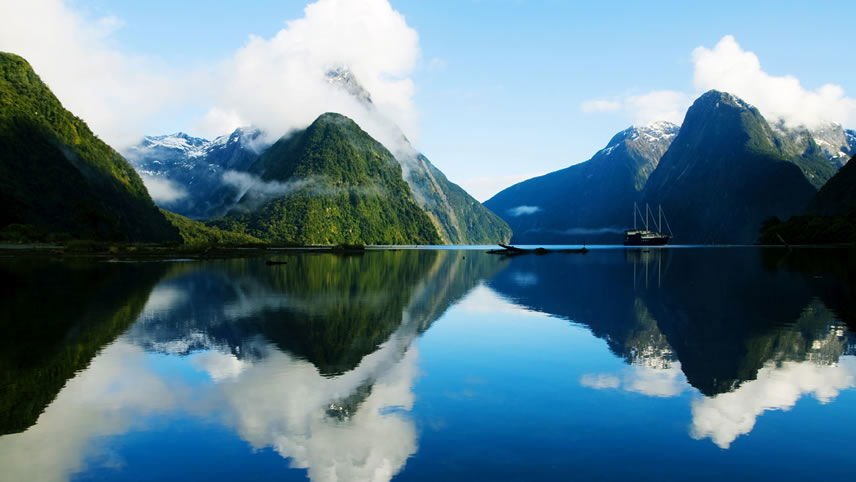
Milford Sound is probably the best-known destination in Fiordland National Park.
Despite its name, Milford Sound is actually a fiord. It extends inland from the Tasman Sea and is surrounded by spectacular mountains.
The landscape around Milford Sound is dominated by steep cliffs, dark waters, rainforest, and waterfalls.
One of its most recognizable mountains is Mitre Peak. The mountain rises dramatically beside the water and has become one of the most photographed landscapes in New Zealand.
Boat cruises are one of the most popular ways to experience Milford Sound. Boats travel along the water, allowing visitors to see cliffs, waterfalls, mountains, and wildlife from different perspectives.
After rainfall, the number of visible waterfalls can increase dramatically. Temporary waterfalls may appear across the cliffs, while permanent waterfalls continue flowing throughout the year.
Mitre Peak
Mitre Peak is one of the iconic natural landmarks of Fiordland.
Its distinctive shape makes it easily recognizable from Milford Sound.
The mountain rises dramatically from the surrounding landscape and creates an impressive vertical scene when viewed from the water.
Photographers often visit Milford Sound specifically to capture Mitre Peak during changing weather conditions.
The mountain can look completely different depending on whether the sky is clear, cloudy, rainy, or covered with mist.
Doubtful Sound
Doubtful Sound is another extraordinary destination within the Fiordland region.
It is considerably larger and generally quieter than Milford Sound.
Doubtful Sound is surrounded by dense forests and towering mountains. Its remote character makes it particularly attractive to travelers looking for a quieter wilderness experience.
Visitors commonly reach Doubtful Sound by crossing Lake Manapouri and then traveling through the surrounding mountain landscape before reaching the fiord.
Boat journeys through Doubtful Sound can take several hours, giving visitors plenty of time to appreciate the remote scenery.
The area is also known for marine wildlife, including dolphins, seals, and seabirds.
Lake Te Anau
Lake Te Anau is the largest lake in the South Island and an important part of the Fiordland landscape.
The town of Te Anau sits beside the lake and acts as a major base for exploring the national park.
The lake is surrounded by mountains and forests, creating beautiful views throughout the region.
Lake Te Anau is also important for recreation and tourism. Visitors can enjoy boat trips, kayaking, fishing, scenic walks, and photography.
One famous attraction associated with the lake is the Te Ana-Au Caves, known for their underground formations and glowworms.
Lake Manapouri
Lake Manapouri is another beautiful lake near Fiordland National Park.
It is surrounded by mountains and has numerous islands and arms extending into the surrounding landscape.
The lake is an important starting point for journeys toward Doubtful Sound.
Its clear waters, mountain scenery, forests, and peaceful atmosphere make it a destination in its own right.
The combination of Lake Manapouri and Doubtful Sound creates one of the most memorable wilderness experiences in the region.
Fiordland’s Mountains
The mountains of Fiordland are among the most dramatic in New Zealand.
They include sharp ridges, steep slopes, alpine peaks, and deep valleys.
Many mountains remain covered with vegetation at lower elevations while higher areas contain rocky terrain, snow, and alpine plants.
Clouds frequently surround the mountains because of the area’s wet climate.
The combination of mountains and clouds creates a constantly changing landscape.
On clear days, the peaks can appear enormous and sharply defined. During rainy weather, the mountains may disappear into mist, creating a mysterious atmosphere.
The Climate of Fiordland
Fiordland is famous for its extremely wet climate.
The region receives substantial rainfall, particularly on the western side of the mountains.
Although rain can sometimes make outdoor activities challenging, it is also responsible for much of Fiordland’s beauty.
Rainwater feeds streams and waterfalls and keeps the rainforest lush and green.
One of the most beautiful experiences in Fiordland is visiting shortly after rainfall, when waterfalls appear across the cliffs.
Visitors should therefore expect changeable weather.
A sunny morning does not guarantee a dry afternoon, and rain can arrive quickly in mountainous areas.
Good waterproof clothing is essential for anyone planning to spend significant time outdoors.
The Rainforests of Fiordland
Fiordland contains extensive temperate rainforest.
The forests are filled with mosses, ferns, trees, vines, and other plants adapted to the wet environment.
Walking through a Fiordland forest can feel completely different from walking through an ordinary woodland.
Moss-covered branches, thick vegetation, dripping leaves, and filtered light create a peaceful atmosphere.
The forests also provide habitat for many native birds and insects.
Some walking tracks pass through dense rainforest before opening into valleys, lakes, rivers, or alpine landscapes.
Wildlife of Fiordland National Park
Fiordland is an important habitat for New Zealand’s native wildlife.
The region’s isolation and variety of environments support numerous species.
Visitors may encounter:
- New Zealand fur seals
- Bottlenose dolphins
- Fiordland penguins
- Kea
- New Zealand wood pigeons
- Takahe
- Native forest birds
- Reptiles
- Insects
- Freshwater species
- Marine animals
Wildlife encounters are one of the most exciting parts of visiting Fiordland.
However, visitors should always maintain a respectful distance and avoid feeding wild animals.
Fiordland Crested Penguin
The Fiordland crested penguin is one of the most special birds associated with the region.
It is also known as the tawaki.
These penguins are found along parts of the southwestern coast of New Zealand and nearby islands.
They have distinctive yellow markings around their eyes and are adapted to a coastal lifestyle.
Seeing one in the wild can be a memorable experience because they are not commonly encountered by ordinary visitors.
Wildlife viewing should always be conducted responsibly to avoid disturbing breeding areas.
Bottlenose Dolphins
Dolphins can sometimes be seen in the waters of Fiordland.
The sheltered waters of the fiords provide an important habitat for marine life.
Bottlenose dolphins are among the species that may be encountered during boat journeys.
Seeing dolphins swimming beside a boat is one of the unforgettable experiences that visitors may enjoy in Fiordland.
However, wildlife sightings are never guaranteed, and responsible tour operators follow rules designed to reduce disturbance.
New Zealand Fur Seals
New Zealand fur seals can also be found around the coastal areas of Fiordland.
They may sometimes be seen resting on rocks near the water.
These animals are adapted to marine life and are capable swimmers.
Visitors should never approach or attempt to touch seals. Wild animals require space, especially when resting or caring for young.
Kea
The kea is one of New Zealand’s most famous native birds.
It is a large alpine parrot known for its intelligence, curiosity, and distinctive calls.
Kea are particularly associated with mountainous areas of the South Island.
Visitors hiking in Fiordland may occasionally encounter them.
Although they can appear friendly and curious, they are wild animals and should never be fed.
Feeding wildlife can cause behavioral and health problems.
Takahe and Conservation
The takahe is one of New Zealand’s most famous conservation stories.
Once thought to be extinct, the bird was rediscovered in the twentieth century.
Fiordland played an important role in the history of takahe conservation.
The species is flightless and depends on native vegetation for food.
Conservation programs have helped protect takahe populations and establish safer habitats.
The story of the takahe demonstrates why protecting natural ecosystems is so important.
Walking and Hiking in Fiordland
Fiordland National Park is internationally famous for hiking.
The region contains some of New Zealand’s Great Walks and many other tracks.
Among the best-known routes are:
- Milford Track
- Kepler Track
- Routeburn Track
- Hollyford Track
- Dusky Track
- Greenstone and Caples Tracks
These walks range from relatively accessible day hikes to challenging multi-day wilderness journeys.
Weather can change quickly, so hikers need appropriate equipment and preparation.
Milford Track
The Milford Track is one of New Zealand’s most famous walking routes.
It passes through spectacular valleys, rainforest, mountains, rivers, waterfalls, and alpine scenery.
The track is often described as one of the world’s great walks.
A multi-day journey allows hikers to experience the wilderness at a slower pace.
The route requires advance planning, especially during the busy hiking season.
Kepler Track
The Kepler Track is another famous walking route near Te Anau.
It offers a mixture of forest, lake views, ridges, valleys, and mountain scenery.
One advantage of the Kepler Track is its accessibility from the Te Anau area.
The route provides an excellent introduction to the different landscapes found around Fiordland.
Routeburn Track
The Routeburn Track connects the Fiordland and Mount Aspiring regions.
It is famous for alpine scenery, mountain valleys, waterfalls, and spectacular viewpoints.
Although the track crosses a mountainous environment, hikers can experience a variety of landscapes within a relatively compact journey.
Scenic Cruises
Visitors who do not want to undertake long hikes can still experience Fiordland through scenic cruises.
Boat cruises are particularly popular at Milford Sound and Doubtful Sound.
A cruise provides a comfortable way to see:
- Mountain cliffs
- Waterfalls
- Rainforest
- Marine wildlife
- Islands
- Deep waters
- Glacial landscapes
Cruises are suitable for visitors of many ages and fitness levels.
Kayaking in Fiordland
Kayaking offers a more intimate way to experience the waterways.
Paddling quietly through a fiord can provide a different perspective from a large cruise boat.
Kayakers may be able to explore quieter areas and observe the surrounding environment at close range.
Because weather and water conditions can change quickly, visitors should use appropriate equipment and follow local safety advice.
Guided kayaking trips can be a good option for people unfamiliar with the region.
Photography in Fiordland
Fiordland is a dream destination for landscape photographers.
Almost every part of the region provides opportunities for dramatic photographs.
Popular subjects include:
- Mitre Peak
- Waterfalls
- Lakes
- Mountains
- Rainforest
- Clouds
- Reflections
- Wildlife
- Sunrise and sunset scenes
Rain should not be considered a disadvantage for photographers.
Wet weather often creates mist, additional waterfalls, dramatic clouds, and reflective surfaces.
A waterproof camera cover or protective equipment can be useful.
Waterfalls of Fiordland
Waterfalls are among the most recognizable features of the region.
Because of heavy rainfall, water frequently pours from the mountains into the fiords.
Some waterfalls are permanent, while many temporary waterfalls appear after heavy rain.
The cliffs around Milford Sound can become covered with streams and waterfalls following a major rainstorm.
Two famous waterfalls around Milford Sound are Stirling Falls and Lady Bowen Falls.
These waterfalls demonstrate the power of water in shaping the landscape.
Stirling Falls
Stirling Falls is one of the most famous waterfalls in Milford Sound.
It drops dramatically from the surrounding mountains toward the fiord.
Boat cruises often approach the waterfall, allowing visitors to experience its impressive scale.
On rainy days, the surrounding cliffs may contain numerous additional waterfalls.
Lady Bowen Falls
Lady Bowen Falls is another well-known waterfall near Milford Sound.
It is an important natural feature and contributes to the dramatic scenery of the area.
The waterfall is especially impressive after periods of rainfall.
Māori Heritage and Fiordland
Fiordland has a deep cultural history.
Māori people have long known and used the region, traveling through its waterways and landscapes and developing knowledge of its plants, animals, and natural resources.
Traditional Māori names remain an important part of the region.
The landscape is not simply wilderness in a modern conservation sense. It is also part of a cultural landscape with generations of human history.
Visitors should respect the cultural significance of the area and follow local guidance.
Geological History
Fiordland’s geology is extremely old and complex.
The region has been shaped by tectonic forces associated with the movement of Earth’s crust.
Over immense periods of time, uplift created mountains, while erosion gradually modified the landscape.
Glaciers later played a major role.
During ice ages, enormous quantities of ice moved through the valleys.
Glacial erosion deepened and widened valleys and helped create the distinctive U-shaped landscape visible today.
The resulting combination of geological activity and glacial erosion created the fiords.
Why Fiordland Is So Green
One of the first things visitors notice about Fiordland is its intense green color.
The reason is simple: water.
The region receives large amounts of rainfall, creating ideal conditions for forests, mosses, ferns, and other vegetation.
Rainwater supports rivers, streams, and waterfalls while keeping the soil and vegetation moist.
The result is a landscape that can remain green throughout much of the year.
Fiordland as a World Heritage Area
Fiordland forms part of Te Wāhipounamu, a large UNESCO World Heritage site in southwestern New Zealand.
The wider World Heritage area is recognized for its exceptional natural landscapes, geological history, biodiversity, and relatively undisturbed ecosystems.
This international recognition highlights the importance of protecting the region.
It also demonstrates that Fiordland is significant not only to New Zealand but to global natural heritage.
Conservation Challenges
Despite its remote appearance, Fiordland faces conservation challenges.
Introduced animals can threaten native wildlife.
Species such as stoats, rats, possums, and other introduced predators can affect native birds and ecosystems.
New Zealand has many bird species that evolved without the mammalian predators found in other parts of the world.
As a result, some native species are particularly vulnerable.
Conservation programs therefore focus on predator control, habitat protection, monitoring, and species recovery.
Responsible Tourism
Tourism provides an opportunity for people to experience Fiordland, but it also creates responsibilities.
Visitors can help protect the park by:
- Taking rubbish away
- Staying on marked tracks
- Avoiding disturbance of wildlife
- Not feeding animals
- Following fire regulations
- Respecting cultural sites
- Following biosecurity requirements
- Using designated facilities
- Respecting other visitors
Small actions can make a major difference when millions of people visit natural areas over time.
Best Time to Visit Fiordland
Fiordland can be visited throughout the year, but different seasons offer different experiences.
Summer
Summer generally provides longer daylight hours and is popular for hiking and outdoor activities.
However, it is also a busy period.
Advance planning may be necessary for popular walks and accommodation.
Autumn
Autumn can bring beautiful colors to some parts of the landscape.
The weather may become cooler, but the quieter atmosphere can appeal to travelers.
Winter
Winter brings shorter days, colder conditions, and snow in higher areas.
Some tracks and facilities may have seasonal limitations.
Experienced travelers can enjoy dramatic winter scenery, but preparation is essential.
Spring
Spring brings fresh vegetation and increased water flow.
Rainfall can produce spectacular waterfalls.
Spring can be an excellent time for photographers and nature lovers.
How Long Should You Spend in Fiordland?
The ideal length of a Fiordland visit depends on your interests.
A short trip of two or three days can allow visitors to explore Te Anau and take a trip to Milford Sound.
A longer stay of four to seven days allows more time for hiking, kayaking, scenic cruises, and exploring the surrounding lakes.
Hikers undertaking multi-day tracks will naturally need additional time.
Because Fiordland is remote and weather can change quickly, allowing extra time is often a good idea.
Getting to Fiordland
Most visitors enter Fiordland through Te Anau or Manapouri.
Travelers can reach the region by road from other parts of New Zealand’s South Island.
Te Anau is a major base for visitors traveling toward Milford Sound.
Scenic flights are also available through operators in the wider region, offering aerial views of mountains, valleys, and fiords.
Travel conditions can vary depending on weather.
Visitors should check current road, track, and weather conditions before beginning a journey.
Milford Road
The road from Te Anau toward Milford Sound is one of the most scenic roads in New Zealand.
It passes through mountains, forests, valleys, and dramatic landscapes.
The journey itself can be considered part of the Fiordland experience.
Drivers should allow plenty of time because there are numerous scenic areas along the way.
Weather conditions can also affect travel.
Things to Pack
Visitors should prepare for unpredictable weather.
Useful items include:
- Waterproof jacket
- Warm layers
- Comfortable walking shoes
- Waterproof footwear for hikes
- Backpack
- Water bottle
- Food and snacks
- Sun protection
- Insect protection
- Camera
- Extra clothing
- First-aid supplies
- Navigation equipment
For multi-day hikes, additional specialist equipment may be required.
Always follow current guidance from New Zealand’s Department of Conservation before beginning a wilderness trip.
Safety in Fiordland
Fiordland is beautiful but can also be challenging.
The wilderness environment means visitors should take safety seriously.
Important considerations include:
Weather
Rain, wind, snow, and low cloud can appear quickly.
Rivers
Heavy rainfall can cause rivers and streams to rise rapidly.
Mountains
Steep terrain and slippery tracks can create hazards.
Isolation
Some areas are far from roads and emergency services.
Navigation
Visitors should understand their route before leaving.
Anyone undertaking a remote hike should be properly equipped and should tell someone about their plans.
Why Rain Makes Fiordland Special
Many tourists initially worry about rain.
However, rain is actually one of the features that makes Fiordland extraordinary.
After rainfall, hundreds of waterfalls can appear across mountain cliffs.
Clouds descend into valleys.
Mist surrounds the peaks.
Forests become intensely green.
Streams become more powerful.
The landscape can therefore become even more dramatic during wet weather.
A rainy day in Fiordland is not necessarily a bad day.
The Sound of Fiordland
Fiordland is not only visually impressive.
It is also a place of extraordinary natural sounds.
Visitors may hear:
- Flowing rivers
- Waterfalls
- Wind through forests
- Native birds
- Waves
- Rain
- Distant echoes from mountains
In remote locations, the absence of urban noise can be striking.
This quietness is one of the reasons many people describe Fiordland as a deeply peaceful place.
Fiordland for Families
Families can enjoy Fiordland through scenic cruises, short walks, boat journeys, and educational experiences.
Not every activity requires strenuous hiking.
Families should choose activities according to weather conditions, children’s ages, and individual fitness levels.
Short walks near Te Anau can provide beautiful scenery without requiring a multi-day wilderness journey.
Boat cruises can also be an excellent family-friendly way to experience the fiords.
Fiordland for Adventure Travelers
Adventure travelers have countless opportunities in the region.
Activities can include:
- Multi-day hiking
- Kayaking
- Mountain exploration
- Backcountry camping
- Scenic flights
- Fishing
- Photography
- Wildlife observation
Experienced hikers can explore more remote tracks, while beginners can choose guided activities.
Fiordland for Nature Lovers
Nature lovers will find an enormous variety of environments.
The park combines mountains, freshwater, forests, wetlands, alpine areas, coastlines, and marine ecosystems.
This diversity means visitors can encounter very different environments during the same trip.
A morning might begin beside a lake, continue through rainforest, and end beside a massive fiord surrounded by mountains.
The Importance of Protecting Fiordland
Fiordland is valuable because it represents a relatively large and wild natural environment.
Protecting such areas helps conserve biodiversity and ecological processes.
National parks also provide opportunities for scientific research and environmental education.
The park’s forests capture carbon, its waterways support ecosystems, and its mountains provide habitats for specialized species.
Protecting Fiordland therefore benefits both nature and future generations.
Tips for First-Time Visitors
First-time visitors should keep several things in mind.
Plan Ahead
Popular activities and accommodation can fill quickly during busy seasons.
Expect Rain
Do not plan a Fiordland trip assuming every day will be sunny.
Bring Layers
Temperatures can change quickly.
Allow Extra Time
Weather or road conditions can affect plans.
Respect Wildlife
Observe animals from a safe distance.
Follow Track Rules
Do not leave marked trails without proper preparation.
Check Conditions
Always review current weather, track, road, and safety information.
Frequently Asked Questions
What is Fiordland National Park famous for?
Fiordland is famous for its spectacular fiords, mountains, rainforests, lakes, waterfalls, wildlife, and world-class hiking trails.
Where is Fiordland National Park located?
It is located in the southwestern part of New Zealand’s South Island.
Is Milford Sound inside Fiordland National Park?
Yes. Milford Sound is one of the best-known natural attractions within Fiordland National Park.
What is the best time to visit Fiordland?
Fiordland can be visited throughout the year. Summer is popular for hiking, while spring and rainy periods can provide spectacular waterfalls.
Does Fiordland receive a lot of rain?
Yes. Fiordland is one of the wetter regions of New Zealand, and rainfall plays an important role in maintaining its forests, streams, and waterfalls.
Can you hike in Fiordland National Park?
Yes. The park is famous for hiking, including the Milford Track, Kepler Track, Routeburn Track, and several other routes.
Can you see wildlife in Fiordland?
Yes. Visitors may encounter native birds, dolphins, seals, penguins, and other wildlife, although sightings are never guaranteed.
Is Fiordland suitable for families?
Yes. Families can enjoy scenic cruises, short walks, lake activities, and other attractions without necessarily undertaking difficult hikes.
What should I bring to Fiordland?
Waterproof clothing, warm layers, comfortable footwear, food, water, sun protection, and appropriate safety equipment are useful.
Why are there so many waterfalls in Fiordland?
The region receives heavy rainfall, and water flows from the mountains toward the fiords. After rain, many temporary waterfalls appear on the cliffs.
Conclusion
Fiordland National Park is one of the world’s great wilderness destinations. Its combination of towering mountains, deep fiords, ancient rainforest, powerful waterfalls, clear lakes, and rare wildlife creates a landscape unlike almost anywhere else.
Milford Sound may be its most famous attraction, but Fiordland is much larger than one destination. Doubtful Sound, Lake Te Anau, Lake Manapouri, the Kepler Track, Milford Track, Routeburn Track, and countless remote valleys and waterways all contribute to the region’s extraordinary character.
The park also demonstrates the importance of conservation. Its native wildlife, forests, rivers, mountains, and marine environments represent an important part of New Zealand’s natural heritage.
For travelers, Fiordland offers opportunities for adventure, relaxation, photography, wildlife observation, hiking, boating, and quiet reflection.
Whether viewed from a cruise boat, explored on foot, photographed from a mountain viewpoint, or simply experienced beside a peaceful lake, Fiordland has the ability to leave a lasting impression.
Its greatest attraction is perhaps its wildness. In a world where many landscapes have been heavily developed, Fiordland remains a place where mountains, forests, water, weather, and wildlife continue to dominate.
For anyone interested in spectacular natural places, Fiordland National Park deserves a place among the world’s most remarkable destinations.



One Comment