Rub’ al Khali, Arabia: Complete Guide to the Empty Quarter, the World’s Largest Sand Desert
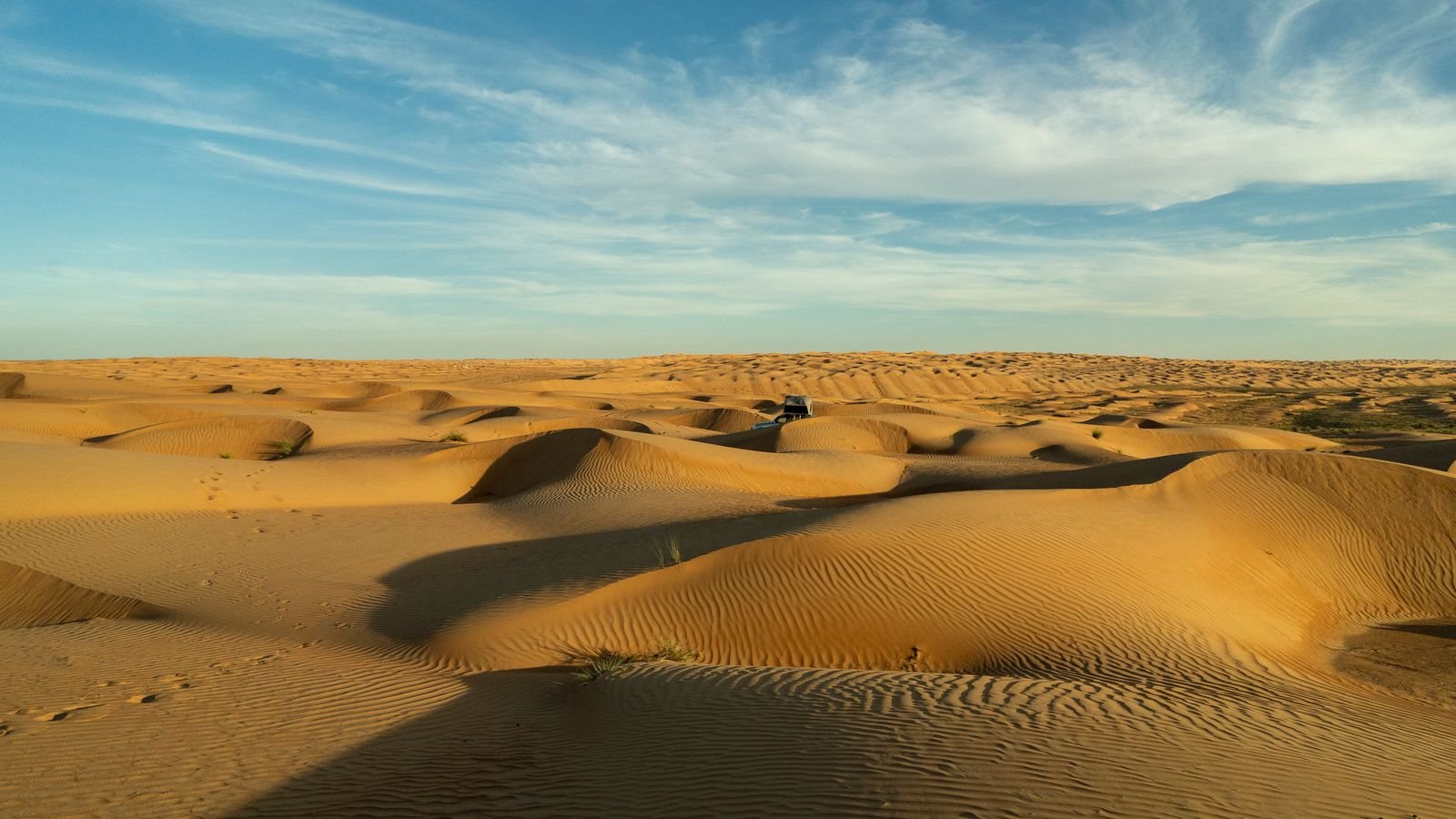
The Rub’ al Khali, which means the Empty Quarter in Arabic, is the largest sand desert in the world, a vast sea of dunes covering more than 650,000 square kilometres of the Arabian Peninsula, across Saudi Arabia, Oman, the United Arab Emirates and Yemen. It is a desert of extraordinary scale and beauty, with dunes that rise to 250 metres, more than the height of a 70-storey building, and that stretch to the horizon in every direction, in shades of gold, orange and red. The Rub’ al Khali is one of the most remote and least visited deserts in the world, and it is also one of the most rewarding, for those who travel with a guide, a 4×4 and a sense of adventure. The Rub’ al Khali is a place of silence, stars and sand.
This guide covers everything you need to plan a trip to the Rub’ al Khali: where it is, how to visit it from Oman, Saudi Arabia or the United Arab Emirates, the best desert camps and experiences, camel trekking, dune bashing and stargazing, the history of the Empty Quarter, the wildlife and plants that live in the dunes, and practical tips for safety and preparation. Whether you spend a night in a luxury desert camp or travel for a week on a camel expedition, the Rub’ al Khali offers a desert experience unlike any other.
Where Is the Rub’ al Khali?
The Rub’ al Khali is in the south of the Arabian Peninsula, and it is the largest continuous sand desert in the world. It covers an area about the size of France, and it is mostly in Saudi Arabia, with its eastern edge in Oman and the United Arab Emirates, and its southern edge in Yemen. The desert is a vast, flat plain of sand, with dunes that are shaped by the wind into ridges, crescents and stars, and with gravel plains, salt flats and sabkhas, or salt flats, between the dunes. The Rub’ al Khali is one of the driest places on Earth, with less than 35 millimetres of rain a year in most places, and with temperatures that can reach 55 degrees Celsius in summer and fall below freezing on winter nights. The desert is almost entirely empty of permanent settlements, with only a few oases, Bedouin camps and oil installations.
The Dunes of the Empty Quarter
The dunes of the Rub’ al Khali are its defining feature, and they are among the largest in the world. The dunes are made of fine, red-orange sand, and they are shaped by the wind into long ridges, or seifs, that can run for hundreds of kilometres, and into crescent-shaped barchans and star dunes. The tallest dunes are in the south-west of the desert, in Saudi Arabia, where they reach 250 metres, and they are a spectacular sight at sunrise and sunset, when the light turns the sand gold and the shadows are long. Walking on the dunes is a wonderful experience, although it is hard work, because the sand is soft and deep, and climbing a dune is a good workout. The dunes are also a place of silence, with no sound except the wind and your own footsteps, and at night, the sky above the dunes is one of the darkest and clearest in the world.

How to Visit the Rub’ al Khali
The Rub’ al Khali should only be visited with a guide and a 4×4 vehicle, because it is remote, with no roads, no signs, no mobile signal and no water, and it is easy to get lost. The easiest way to visit is from Oman, where desert camps in the Wahiba Sands, on the edge of the Empty Quarter, offer overnight stays, camel rides and dune drives, and where longer expeditions into the Rub’ al Khali can be arranged. From the United Arab Emirates, desert camps near Liwa, on the edge of the Empty Quarter, offer similar experiences, with dune bashing, camel rides and overnight stays in a Bedouin-style camp. From Saudi Arabia, expeditions into the Empty Quarter can be arranged from Riyadh or from the south, although they require more planning, a permit and a guide. Whichever route you choose, you should book with a reputable operator, and you should be prepared for a desert expedition, with water, food, sun protection and warm clothes for the night.
Desert Camps, Camel Treks and Dune Bashing
Desert camps are the best way to experience the Rub’ al Khali, and they range from simple Bedouin-style camps with tents and campfires to luxury camps with comfortable beds, private bathrooms, restaurants and swimming pools. A typical desert camp stay includes a sunset dune drive, a camel ride, a barbecue dinner under the stars, and a night in a tent, followed by a sunrise walk on the dunes. Camel treks are a slower and more traditional way to explore the desert, and they can last from a few hours to several days, with camels carrying your gear and a guide leading the way. Dune bashing, or driving a 4×4 over the dunes, is an exciting and popular activity, especially in the United Arab Emirates, although it should only be done with an experienced driver, because the dunes are steep and soft, and it is easy to get stuck.
Stargazing in the Empty Quarter
The Rub’ al Khali is one of the best places in the world for stargazing, because it is far from any city lights, with almost no light pollution, and the air is dry and clear. On a clear night, the Milky Way is bright and vivid, and you can see thousands of stars, planets, and the Andromeda Galaxy with the naked eye. Many desert camps offer stargazing, with telescopes and guides who can point out the constellations, and the experience of lying on the sand and looking up at the stars is one of the highlights of a trip to the Empty Quarter. The best time for stargazing is on a moonless night, in winter, when the air is cool and clear, and the sky is at its darkest.
Best Time to Visit the Rub’ al Khali
The best time to visit the Rub’ al Khali is in winter, from November to March, when the weather is mild, with daytime temperatures of 25 to 30 degrees Celsius and cool nights of 5 to 10 degrees, and the desert is at its most comfortable. Winter is also the busiest season, with the most visitors, and desert camps should be booked in advance. Spring and autumn, from March to April and from October to November, are also good, with warm days and fewer visitors, although the days can be hot. Summer, from May to September, is extremely hot, with temperatures above 50 degrees Celsius, and it is dangerous to be in the desert, although the camps are still open, with air conditioning and pools. The Rub’ al Khali is a year-round destination, but winter offers the best weather for most visitors, and summer should only be visited by those who are prepared for the heat.
History of the Empty Quarter: Wilfred Thesiger and the Bedouin
The Rub’ al Khali has a rich history, and it is best known through the writings of Wilfred Thesiger, a British explorer who crossed the Empty Quarter by camel in the 1940s, with Bedouin guides, and who wrote about it in his classic book, Arabian Sands. Thesiger described the desert as a place of great beauty and hardship, and he wrote about the Bedouin who lived there, their hospitality, their knowledge of the desert, and their way of life. The Bedouin, or Bedu, are the nomadic people of the Arabian desert, and they have lived in and around the Rub’ al Khali for centuries, herding camels and goats, and moving between the oases and the grazing lands. Today, most Bedouin live in towns and villages, but some still travel in the desert, and their knowledge and hospitality are still an important part of a trip to the Empty Quarter. Like the Sahara Desert in Morocco, the Rub’ al Khali is a desert of dunes and camel treks, but the Empty Quarter is larger, more remote and emptier, with dunes that are taller and more continuous, and it is the largest sand desert in the world.
Wildlife and Plants of the Rub’ al Khali
Despite its harshness, the Rub’ al Khali is home to wildlife and plants that have adapted to the desert. Animals include the Arabian oryx, a white antelope with long, straight horns, which was once extinct in the wild but has been reintroduced in Oman and Saudi Arabia, the sand gazelle, the red fox, the desert hare, the sand cat, and the Arabian wolf. Birds include the desert lark, the hoopoe lark, the brown-necked raven, and the Egyptian vulture. Plants include the ghaf tree, a hardy desert tree, the saxaul, a shrub that grows in the dunes, and the desert truffle, a fungus that grows underground after rain. The wildlife of the Empty Quarter is elusive and hard to see, but it is a reminder that even the most extreme desert is alive, and that the desert is a place of great ecological interest.
Practical Tips: Safety and Preparation for the Empty Quarter
The Rub’ al Khali is a remote and dangerous place if you are not prepared, and it is important to travel with a guide and a 4×4, and to be prepared for the heat, the cold and the lack of water. Bring plenty of water, at least four litres per person per day, and drink regularly. Wear a hat, sunscreen and light, loose clothing, and bring warm clothes for the night, because the temperature can fall below freezing in winter. Do not travel alone, do not rely on mobile signal, and let someone know your plans. Check your vehicle, because the sand can cause tyres and engines to fail, and carry a spare tyre, extra water and a satellite phone. The Danakil Depression in Ethiopia is one of the hottest and lowest places on Earth, with volcanoes and salt flats, and it is, like the Rub’ al Khali, one of the most extreme and remote places in the world, and both require a guide, a 4×4 and careful preparation.
Conclusion
The Rub’ al Khali is a desert of extraordinary scale and beauty, and it is one of the great wildernesses of the world. It is the largest sand desert on Earth, with dunes that rise to 250 metres and stretch to the horizon, and it is a place of silence, stars and sand. It is a desert that demands respect, preparation and a guide, and it rewards those who take the time to travel slowly, to walk on the dunes, to ride a camel, and to spend a night under the stars. Visit in winter, travel with a guide, and the Empty Quarter will give you one of the great desert experiences of your life.
Frequently Asked Questions About the Rub’ al Khali
Where is the Rub’ al Khali?
The Rub’ al Khali, or Empty Quarter, is in the south of the Arabian Peninsula, across Saudi Arabia, Oman, the United Arab Emirates and Yemen, and it is the largest sand desert in the world, covering more than 650,000 square kilometres.
How can you visit the Rub’ al Khali?
The best way to visit the Rub’ al Khali is with a guide and a 4×4, from Oman, the United Arab Emirates or Saudi Arabia, staying overnight in a desert camp, and booking with a reputable operator.
When is the best time to visit the Rub’ al Khali?
The best time to visit the Rub’ al Khali is in winter, from November to March, when the weather is mild, with daytime temperatures of 25 to 30 degrees Celsius and cool nights.
Is it safe to visit the Empty Quarter?
Visiting the Rub’ al Khali is safe if you travel with a guide and a 4×4, bring plenty of water, and are prepared for the heat and the cold, but you should not travel alone or without a guide, because the desert is remote, with no roads, no signs and no mobile signal.
How tall are the dunes in the Rub’ al Khali?
The dunes in the Rub’ al Khali can reach 250 metres in height, making them among the tallest sand dunes in the world.