
Arches National Park, Utah: Complete Guide to Delicate Arch, the Windows and the Best Hikes
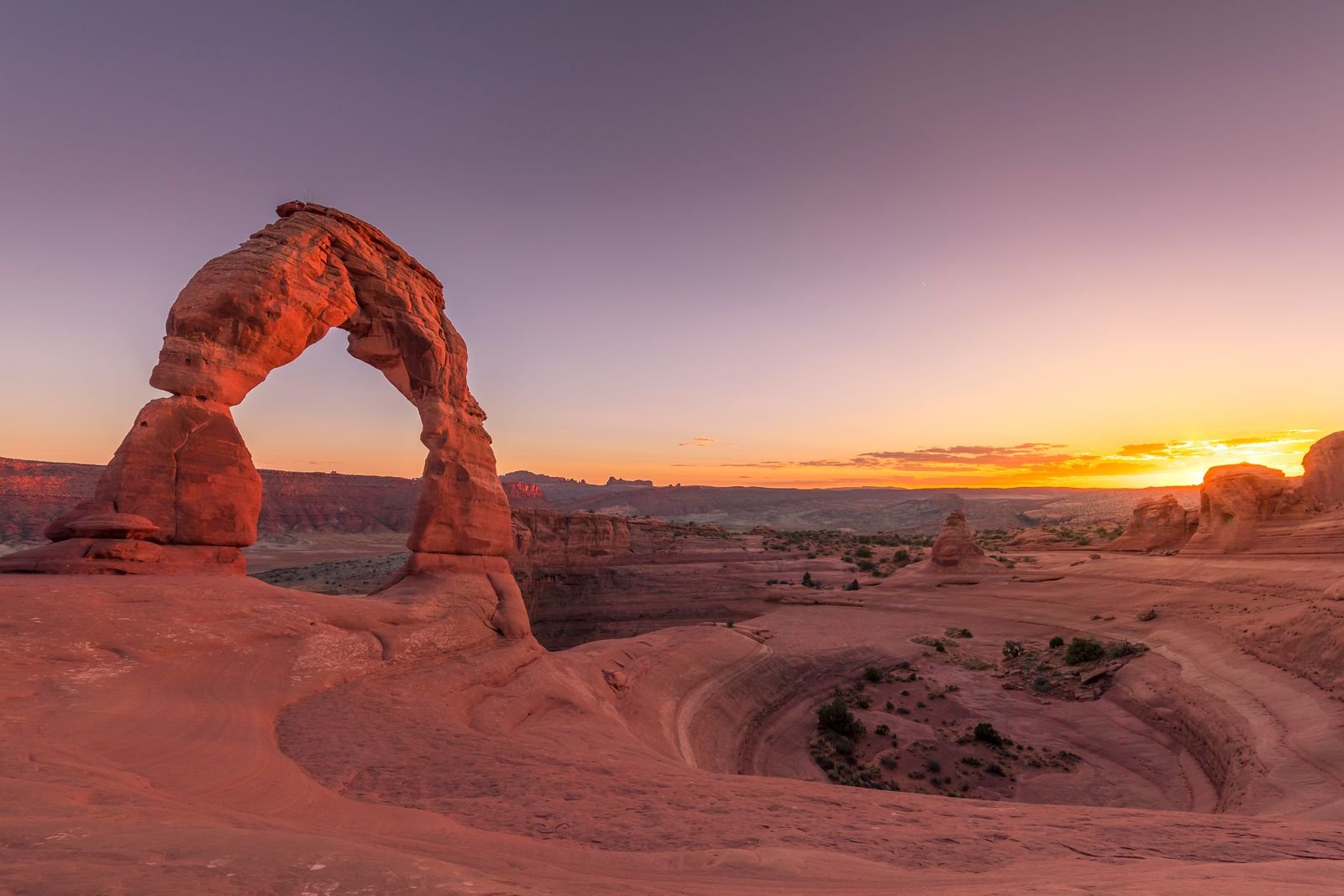
Arches National Park is one of the most extraordinary landscapes in the American West. In a high desert of red rock near Moab, Utah, more than 2,000 natural sandstone arches rise from the canyon floor — windows, bridges, and fins carved by wind, water, and time. The most famous of them all is Delicate Arch, a freestanding span of red rock that has become the symbol of Utah, appearing on the state’s license plates and in a thousand photographs. But Arches is far more than one famous arch: it is a whole park of stone sculpture, with the Windows, Landscape Arch, Double Arch, Balanced Rock, and the labyrinth of the Fiery Furnace, all waiting to be explored on foot.
Arches is a park that rewards walking. The scenic drive is beautiful, but the real magic happens on the trails: the climb to Delicate Arch at sunset, the walk through the Windows at dawn, the long loop through Devil’s Garden, and the scramble through the Fiery Furnace with a ranger. This guide covers everything you need to plan your visit: when to go, how the timed entry system works, the best hikes and viewpoints, where to stay, and how to travel safely in the desert heat.
Where Arches Is and How It Was Formed
Arches lies in eastern Utah, about 5 kilometres north of the town of Moab and 380 kilometres southeast of Salt Lake City. The park covers 310 square kilometres of high desert, on the Colorado Plateau, and it is a landscape of Entrada sandstone — a red rock laid down 150 million years ago as sand dunes, and then buried, compressed, and lifted by the forces that raised the plateau.
The arches themselves were formed by erosion. Cracks in the sandstone were widened by water, ice, and wind, until fins of rock were left standing. The fins were then undercut and pierced, forming windows and arches, which continue to grow, collapse, and form anew. Landscape Arch, the longest arch in North America, has a span of 88 metres — and it is still growing: in 1991, a slab of rock the size of a house fell from the arch, and the park closed the trail beneath it. The park is a landscape in motion, and the arches you see today will not be the same in a thousand years.
Arches was protected as a national monument in 1929 and became a national park in 1971. It is now one of the most visited parks in the American West, and it is part of the great Utah canyon country — a landscape of red rock, deep canyons, and wide skies that includes Canyonlands, Capitol Reef, Bryce Canyon, and Zion.
The Best Time to Visit Arches
The best time to visit is in the spring, from March to May, and in the autumn, from September to November, when the days are warm and sunny, and the desert is at its most beautiful. The spring brings wildflowers to the canyon floor, and the autumn brings clear skies and golden light. The summer, from June to August, is very hot — temperatures in the park can reach 40 degrees Celsius — and the trails are exposed, with no shade. The winter, from December to February, is cold, with snow on the red rock, and the park is quiet and beautiful.
Whatever the season, the light is everything. The best times for photography are the early morning and the late afternoon, when the low sun turns the red rock to fire. Delicate Arch at sunset is the classic photograph of Arches, and the Windows at dawn are almost as good. The park is also a certified International Dark Sky Park, and the night sky — with the Milky Way arching over the arches — is one of the great sights of the American West.
Timed entry reservations are required from April to October. The reservations are booked through Recreation.gov, and they are released three months in advance, with a small number released the day before. Book as early as you can, especially for the spring and autumn weekends, when the park fills up. The reservation is for a timed entry window, and once you are in the park, you can stay as long as you like.
Delicate Arch: The Park’s Most Famous Sight
Delicate Arch is the most famous arch in the park, and it is worth every step of the climb. The trail is 4.8 kilometres round trip, with a climb of 150 metres, and it takes about two to three hours. The trail starts at the Wolfe Ranch, crosses a slickrock slope, and then climbs to the rim of a natural amphitheatre, where the arch stands alone against the sky. The arch is 20 metres high and 10 metres wide, and it is a freestanding span of red rock — a window that frames the La Sal Mountains in the distance.
The best time to hike to Delicate Arch is the late afternoon, when the sun lights up the arch and the crowds gather for sunset. The arch is at its most beautiful in the last hour of light, when the red rock glows orange and gold. Arrive early if you want a photograph without people in it — the arch is popular, and the sunset crowd can be large. The trail is exposed, with no shade and no water, so bring plenty of water, wear a hat, and start early in the summer.
On the way to the trailhead, stop at the Wolfe Ranch, a historic homestead from the early 1900s, and at the Ute petroglyphs — rock art carved by the Ute people, who lived in this area for centuries. The petroglyphs are a reminder that the park has been a place of human history for a long time, and that the arches were sacred to the people who lived here long before the park was created.
The Windows, Double Arch, and Balanced Rock
The Windows Section is the most accessible part of the park, and it is a good place to start. The North Window and the South Window are two great arches side by side, with Turret Arch nearby, and a short loop trail takes you through and around them. The Windows are at their best in the morning, when the sun shines through the arches, and the views across the valley are superb.
Double Arch is a short walk from the Windows, and it is one of the most impressive arches in the park: two arches that share a common end, forming a great window in the rock. The arch is a popular spot for photography, and it is a good place to sit and watch the light change. Balanced Rock, on the main road, is a great boulder perched on a pedestal of rock, and it is one of the most photographed sights in the park — a reminder of the strange and beautiful forms that erosion can create.
Park Avenue, at the start of the scenic drive, is a canyon of towering fins and spires, named for its resemblance to a city street. A short trail leads down into the canyon, and it is a good introduction to the park’s geology — and a good place to escape the crowds, as most visitors drive past without stopping.
Devil’s Garden and the Fiery Furnace
Devil’s Garden, at the far end of the scenic drive, is the best hiking area in the park. The main trail leads to Landscape Arch, the longest arch in North America, with a span of 88 metres, and a thin, elegant curve of rock that seems too delicate to stand. Beyond Landscape Arch, the primitive loop trail continues to Double O Arch, Dark Angel, and a series of smaller arches, on a loop of 11.5 kilometres that takes four to five hours. The primitive loop is a real hike, with scrambling, exposure, and route-finding, and it is not for everyone — but it is the best way to see the wild side of Arches.
The Fiery Furnace is a labyrinth of narrow canyons and fins, and it can only be visited on a ranger-guided hike. The hike is three hours long, and it involves scrambling, squeezing through narrow passages, and climbing over rocks. It is a challenging hike, but it is one of the great experiences of the park — a journey through a maze of red rock that feels like a different world. Book the ranger hike well in advance, as it often sells out, especially in the spring and autumn.

Hiking in Arches: What to Know
Arches is a hiking park, and the trails are the way to see it. The trails range from short, easy walks — the Windows loop, Double Arch, Balanced Rock — to long, demanding hikes — the Delicate Arch trail, the Devil’s Garden primitive loop, the Fiery Furnace. The trails are well marked, but they are exposed, with no shade and no water, and the desert heat is a real danger in the summer. Carry at least a litre of water per person per hour of hiking, wear a hat and sunscreen, and start early in the day.
The park’s elevation is about 1,500 metres, and the air is dry. Drink more water than you think you need, and be aware of the signs of heat exhaustion: dizziness, nausea, and headache. If you feel unwell, stop, rest in the shade, and drink water. The park’s visitor centre has water, and there are water fountains at the trailheads, but there is no water on the trails themselves. The desert is a beautiful place, but it demands respect.
Where to Stay: Moab and the Canyon Country
Moab, the town just south of the park, is the base for visiting Arches. The town has a range of hotels, motels, and campgrounds, from budget to luxury, and a good selection of restaurants, cafes, and shops. The town is small and walkable, and it has a relaxed, outdoorsy feel — a place where hikers, climbers, and mountain bikers gather after a day in the desert. Book in advance in the spring and autumn, when the town fills up.
The park itself has one campground, Devils Garden Campground, at the far end of the scenic drive. The campground has 51 sites, and it is a beautiful place to stay — with views of the fins and spires, and a night sky full of stars. The sites are reservable from March to October, and they fill up fast, so book as early as you can. Outside the park, there are campgrounds and BLM (Bureau of Land Management) sites along the Colorado River, which are a good alternative.
Arches is often combined with Canyonlands National Park, just south of Moab, and with the other Utah parks — Bryce Canyon, Zion, and Capitol Reef. A week in the Utah canyon country, combining Arches with Canyonlands and the other parks, is one of the great road trips in the American West, and it is worth taking the time to do it properly.
Getting There and Getting Around
Arches is about 380 kilometres southeast of Salt Lake City, a drive of four hours on the interstate, and 550 kilometres west of Denver, a drive of five to six hours. Most visitors fly into Salt Lake City or Denver and drive to Moab, or fly into the small airport at Canyonlands Field, just north of Moab. The park has one entrance, on the north side of Moab, and the scenic drive is 29 kilometres long, with viewpoints and trailheads along the way.
Inside the park, you drive and walk: the scenic drive takes you to the main viewpoints, and the trails take you to the arches. The park is open 24 hours a day, and the visitor centre is open from 9am to 4pm. The entrance fee is $30 per vehicle for seven days, and the America the Beautiful Pass covers entry to all national parks.
Practical Tips for Visiting Arches
Book your timed entry reservation as early as you can, especially for the spring and autumn. Bring more water than you think you need, and wear a hat and sunscreen — the desert sun is fierce, and there is no shade on the trails. Start your hikes early in the day, especially in the summer, when the heat is dangerous by midday. And be prepared for the crowds: Arches is one of the most popular parks in the West, and the main viewpoints and trails can be busy, especially at sunset.
Respect the park and its fragile desert. Stay on the trails and the slickrock, do not walk on the cryptobiotic soil — the dark, crusty soil that is alive with cyanobacteria and that holds the desert together — and do not climb on the arches. The arches are fragile, and the desert is a place of great natural importance. The park is a treasure, and it is up to every visitor to help protect it.
Frequently Asked Questions
Do I need a timed entry reservation for Arches?
Yes, from April to October, timed entry reservations are required. Book through Recreation.gov as early as you can — reservations are released three months in advance, and they often sell out, especially for weekends.
How long does it take to hike to Delicate Arch?
The Delicate Arch trail is 4.8 kilometres round trip, with a climb of 150 metres, and it takes about two to three hours. The trail is exposed, with no shade and no water, so bring plenty of water and start early in the summer.
What is the best time of year to visit Arches?
The spring (March to May) and the autumn (September to November) are the best times, when the weather is warm and sunny. The summer is very hot, and the winter is cold and quiet.
Can I visit Arches and Canyonlands in one trip?
Yes, easily. Canyonlands is just south of Moab, and the two parks are often visited together. Allow at least two days for Arches and one day for the Island in the Sky district of Canyonlands.
Is Arches suitable for children?
Yes, very. The short trails — the Windows, Double Arch, Balanced Rock — are easy and fun for children, and the Delicate Arch trail is manageable for older children. The park is a wonderful introduction to the desert and to geology.
Conclusion
Arches is one of the great landscapes of the American West — a park of red rock, blue sky, and stone sculpture, where more than 2,000 arches rise from the desert floor. Delicate Arch is the most famous sight, but the park is so much more: the Windows, Landscape Arch, Double Arch, the Fiery Furnace, and the long trails through Devil’s Garden. Go in the spring or the autumn, book your timed entry early, hike to Delicate Arch at sunset, and stay for the night sky — the park will reward you with a journey you will never forget. For more red-rock landscapes, read our guides to Monument Valley and Bryce Canyon, and learn more from Arches National Park on Wikipedia.




One Comment