Simpson Desert, Australia: Complete Guide to Red Dunes, Desert Tracks and Outback Travel
The Simpson Desert is one of the great sand deserts of the world, a vast, red landscape in the heart of Australia, where more than 1,100 parallel sand dunes stretch from horizon to horizon. It is a desert of extremes, with scorching days, freezing nights, and a silence that is unlike anywhere else on earth, and it is one of the most rewarding places in Australia for those who are prepared to cross it.
For travellers, the Simpson Desert is the ultimate outback adventure. The desert covers about 176,000 square kilometres, across South Australia, Queensland, and the Northern Territory, and it is crossed by the French Line, a track that runs from west to east over the dunes, and by the Rig Road and the QAA Line, which offer alternative routes. Crossing the Simpson is a rite of passage for Australian four-wheel-drive travellers, and it is a journey that requires preparation, respect, and a sense of adventure.
This guide covers the Simpson Desert in full, from where to go and when to visit to the best tracks, wildlife, and practical tips for a safe crossing. Whether you are driving the French Line, visiting the desert’s edge from Birdsville or Oodnadatta, or simply learning about one of the world’s great deserts, the Simpson has a way of capturing your imagination.
Where Is the Simpson Desert and Why Visit?
The Simpson Desert lies in the centre of Australia, in the Lake Eyre Basin, with its western edge near Oodnadatta in South Australia, its eastern edge near Birdsville in Queensland, and its northern edge near the Northern Territory border. The desert is named after Alfred Allen Simpson, a South Australian businessman and philanthropist, and it was first crossed by Europeans in 1936 by Ted Colson and his team.
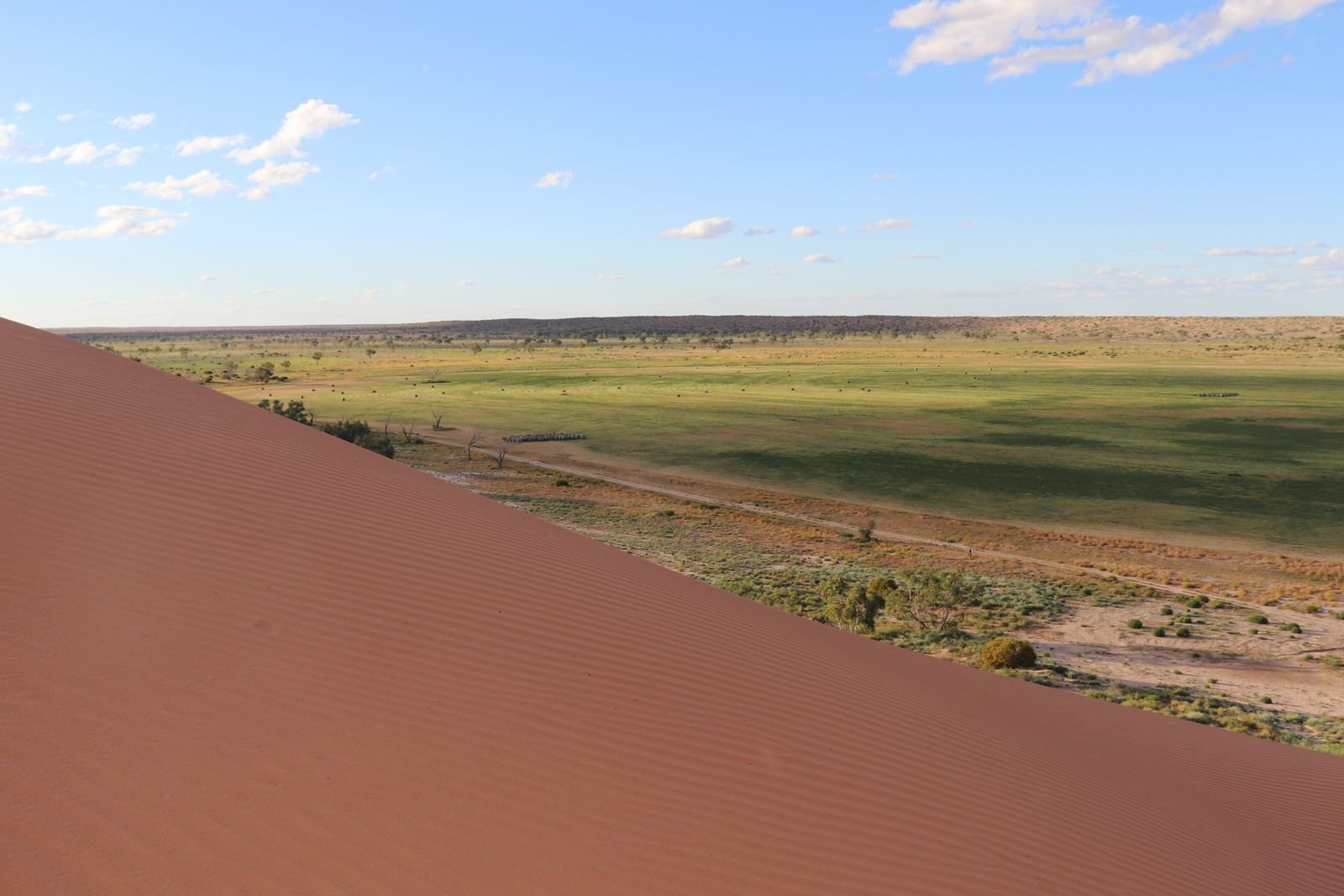
The desert is famous for its dunes, which are among the longest parallel sand dunes in the world. The dunes run north-west to south-east, and they are up to 200 kilometres long, up to 40 metres high, and spaced about a kilometre apart. Between the dunes are clay pans and swales, where wildflowers bloom after rain, and where the desert’s wildlife comes to feed.
What makes the Simpson special is its scale and its silence. The desert is so vast and so empty that it feels like another planet, with red sand, blue sky, and a horizon that seems to go on forever. It is also a desert of surprising life, with red kangaroos, dingoes, and more than 180 species of birds, including the Eyrean grasswren, which is found only in the Simpson Desert.
What Makes the Simpson Desert Special?
The Simpson Desert’s dunes are its most striking feature. The dunes are made of red sand, coloured by iron oxide, and they change colour with the light, from pale pink at dawn to deep red at sunset. The highest dune, Big Red, near Birdsville, is about 40 metres high, and it is the first dune that travellers cross on the French Line, and the last dune they cross on the way back.
The desert’s lakes are another highlight. Lake Eyre, at the southern edge of the Simpson, is the lowest point in Australia, at 15 metres below sea level, and it is the largest lake in Australia when it fills, which happens only a few times a century. When it does fill, it attracts millions of birds, including pelicans, and it transforms the desert into a wetland.
Then there is the desert’s history. The Simpson Desert is the traditional land of the Wangkangurru and Yarluyandi people, who have lived in the desert for thousands of years, and who know its waterholes, its plants, and its animals. The desert was also crossed by early European explorers, including Charles Sturt, who searched for an inland sea, and by the Afghan cameleers who brought camels to Australia in the nineteenth century.
Best Things to Do in the Simpson Desert
Start with a crossing of the Simpson Desert on the French Line, the most famous track in the desert. The French Line runs from Dalhousie Springs in the west to Birdsville in the east, a distance of about 600 kilometres, and it crosses more than 1,100 dunes. The crossing takes three to five days, and it is a journey that requires a well-prepared four-wheel-drive vehicle, plenty of water and fuel, and a Desert Parks Pass.
For a shorter experience, visit the desert’s edge from Birdsville, where you can drive to Big Red, the highest dune in the desert, and watch the sunset over the sand. The town of Birdsville, with its famous hotel and its annual races, is a good base for exploring the eastern Simpson, and it is a place with a rich outback history.
For nature, visit Dalhousie Springs, a group of natural hot springs at the western edge of the desert, where you can swim in warm water surrounded by palm trees, and where the desert’s wildlife comes to drink. The springs are an oasis in the desert, and they are a good place to start or to finish a crossing of the Simpson.
Best Time to Visit the Simpson Desert
The best time to visit the Simpson Desert is from May to September, during the Australian winter, when the days are warm and the nights are cool. June, July, and August are the most popular months, with daytime temperatures of about 20 to 25 degrees Celsius, and with the desert at its most accessible. The desert is closed from 1 December to 15 March each year, when the summer heat makes travel dangerous, with temperatures above 45 degrees Celsius.
Winter is also the best time for wildlife, as the desert’s animals are most active in the cooler months, and the wildflowers bloom after winter rain. The Birdsville Races, held in early September, are a highlight of the outback calendar, with thousands of visitors coming to Birdsville for horse racing, music, and outback hospitality. If you are planning a crossing, book your Desert Parks Pass well in advance, as the number of vehicles is limited in the peak season.

How to Get to the Simpson Desert and Get Around
Most visitors reach the Simpson Desert from Birdsville in Queensland or from Oodnadatta in South Australia. Birdsville is reached by road from Brisbane or from Mount Isa, with a flight to Birdsville Airport from Brisbane, while Oodnadatta is reached by road from Adelaide via the Oodnadatta Track, one of the great outback drives in Australia.
Once in the desert, the only way to travel is by four-wheel-drive vehicle, with high clearance, low-range gearing, and plenty of water, fuel, and food. The French Line is a one-way track from west to east, to reduce the risk of head-on collisions on the dunes, and the Rig Road and the QAA Line offer alternative routes. Travellers must carry a Desert Parks Pass, a satellite phone or a personal locator beacon, and they must register their travel plans with the authorities.
Where to Stay in the Simpson Desert
There are no hotels in the Simpson Desert itself, and most travellers camp in the desert, at designated campsites along the French Line and at Dalhousie Springs. Camping in the desert is a highlight for many visitors, with clear skies, brilliant stars, and a silence that is unlike anywhere else. Campers must be self-sufficient, with water, food, and fuel, and they must follow Leave No Trace principles.
For a more comfortable stay, Birdsville and Oodnadatta offer hotels, motels, and caravan parks, with restaurants, fuel, and supplies. Birdsville is the best base for the eastern Simpson, with the Birdsville Hotel, a famous outback pub, and with a range of accommodation, while Oodnadatta is the best base for the western Simpson, with the Pink Roadhouse, a famous outback roadhouse.
Wildlife and Nature in the Simpson Desert
The Simpson Desert is home to a surprising range of wildlife, adapted to a dry, hot climate. The desert has red kangaroos, dingoes, and more than 180 species of birds, including the Eyrean grasswren, which is found only in the Simpson Desert, the grey falcon, and the Letter-winged kite. The desert’s clay pans and swales are home to wildflowers after rain, including the Sturt’s desert pea, with its bright red flowers.
The desert’s reptiles are also a highlight, with more than 40 species of lizards and snakes, including the perentie, the largest lizard in Australia, and the thorny devil, a small, spiky lizard that drinks water through its skin. The desert’s wildlife is most active at dawn and at dusk, when the temperature is cooler, and a walk in the desert at these times is a good way to see animals and birds.
Practical Tips for Visiting the Simpson Desert
Preparation is everything in the Simpson Desert. Carry at least 10 litres of water per person per day, plus extra for emergencies, and carry enough fuel for the crossing, with a reserve. A satellite phone or a personal locator beacon is essential, as there is no mobile phone signal in the desert, and travellers must register their travel plans and check in at Birdsville or at Oodnadatta.
Drive safely on the dunes. The French Line is one-way from west to east, so follow the direction, use your headlights, and sound your horn before cresting a dune, as another vehicle may be coming the other way on a side track. Lower your tyre pressures for sand driving, carry recovery gear, and travel with at least one other vehicle if you can. In summer, the desert is closed, so do not attempt a crossing outside the open season.
Finally, respect the desert and its traditional owners. The Simpson Desert is the traditional land of the Wangkangurru and Yarluyandi people, and it is a place of cultural importance. Follow Leave No Trace principles, take all rubbish with you, and do not disturb wildlife or cultural sites. A desert crossing is a privilege, and it should be treated with respect.
More Deserts and Unique Landscapes
If the Simpson Desert has given you a taste for great deserts, there are many more to explore. The Namib Desert in Namibia is the oldest desert in the world, with towering dunes and a rich wildlife, while Salar de Uyuni in Bolivia is the largest salt flat in the world, with a mirror-like surface after rain. Both are very different from the Simpson, and both show how varied the world’s deserts can be.
Frequently Asked Questions About the Simpson Desert
Is the Simpson Desert safe for travellers? Yes, the Simpson Desert is generally safe for well-prepared travellers, with a Desert Parks Pass, a satellite phone, and a suitable four-wheel-drive vehicle. The desert is closed in summer, when the heat is dangerous, and travellers must register their plans and check road conditions before a crossing.
Do I need a permit to cross the Simpson Desert? Yes, you need a Desert Parks Pass, which covers entry to the Simpson Desert and to other South Australian desert parks. The pass can be bought online or in Birdsville and Oodnadatta, and it must be carried with you during the crossing.
How long does it take to cross the Simpson Desert? A crossing on the French Line takes three to five days, depending on conditions and on how many stops you make. The distance from Dalhousie Springs to Birdsville is about 600 kilometres, and the crossing involves more than 1,100 dunes.
What is the best time to cross the Simpson Desert? May to September is the best time, during the Australian winter, when the days are warm and the nights are cool. The desert is closed from 1 December to 15 March, when the summer heat makes travel dangerous.
Can I visit the Simpson Desert without a four-wheel-drive? No, a four-wheel-drive vehicle with high clearance and low-range gearing is essential for a crossing. For a shorter visit, you can drive to Big Red from Birdsville in a four-wheel-drive, or join a guided tour from Birdsville or from Oodnadatta.
Conclusion
The Simpson Desert is one of the great deserts of the world, a vast, red landscape that rewards those who are prepared to cross it. Its dunes, its lakes, and its wildlife make it one of the most rewarding places in Australia, and a crossing is a journey that you will remember for the rest of your life. Whether you drive the French Line, visit Big Red from Birdsville, or simply learn about one of the world’s great sand deserts, the Simpson has a way of staying with you. Plan well, travel respectfully, and leave room for the unexpected, because in the Simpson Desert, the best moments are often the ones you did not plan.