

Cliffs of Moher: Complete Guide to Ireland’s Majestic Sea Cliffs and Coastal Walks
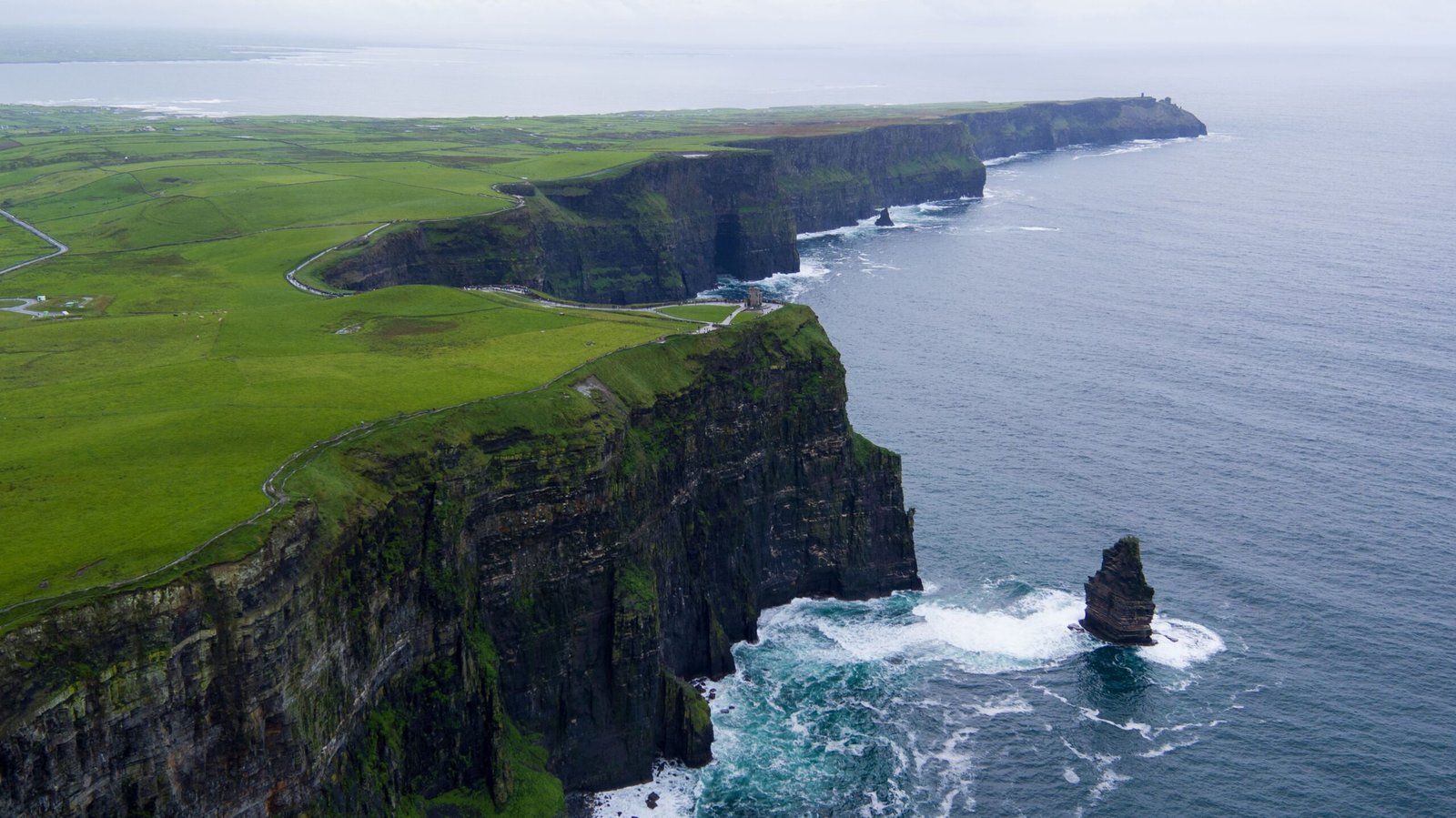
The Cliffs of Moher, on the west coast of Ireland in County Clare, are one of the most famous sea cliffs in the world. For eight kilometres the black shale and sandstone cliffs rise out of the Atlantic, reaching a height of 214 metres at their highest point, and on a clear day you can see the Aran Islands in Galway Bay and the Twelve Bens mountains of Connemara. Around one and a half million people visit every year, and yet the place never feels crowded in the way a city attraction does, because the wind, the seabirds and the sheer scale of the ocean take over as soon as you step onto the cliff path.
This complete guide to the Cliffs of Moher explains how the cliffs formed, what to see and do there, when to visit, how to get there, and how to walk the coastal trail safely. Whether you are coming from Galway, Dublin or the Burren, you will find everything you need to plan your visit to Ireland’s most dramatic coastline.
Where Are the Cliffs of Moher and How Did They Form?
The Cliffs of Moher stand on the Atlantic coast of County Clare, between the villages of Doolin and Liscannor, about 75 kilometres from Galway and 40 kilometres from the town of Ennis. In Irish they are called Aillte an Mothair, the cliffs of the ruined fort, after a ruined promontory fort that once stood at Hag’s Head at the southern end. The cliffs are part of the Burren and Cliffs of Moher UNESCO Global Geopark, which was designated in 2011.
The cliffs are around 320 million years old. They began as layers of sand, silt and mud laid down by ancient rivers flowing into a shallow tropical sea, long before Ireland sat where it does today. Over time these layers hardened into sandstone and shale. The base of the cliffs is dark shale, and the upper layers are sandstone, and the sea has spent millions of years cutting into the softer rock to create the sheer walls, sea stacks and caves you see today. The layers are so clear that you can read the history of a vanished river delta in the stripes of the cliff face.
The tallest point of the cliffs, 214 metres above the sea, is at the viewing area near O’Brien’s Tower, roughly in the middle of the eight-kilometre stretch. From here, and from the cliff edge path to the north, the scale of the place is overwhelming, and on windy days the spray from the waves blows back up the cliff face in what locals call the sea’s own waterfall.
O’Brien’s Tower and the Visitor Experience
The stone tower at the top of the cliffs was built in 1835 by Sir Cornelius O’Brien, a local landowner and Member of Parliament, as a viewing tower for the tourists who were already coming to see the cliffs in the 19th century. The tower is open in the summer months, and from its top you get the best panoramic view in the whole area, across Galway Bay to the Aran Islands and the mountains of Connemara.
Beside the tower stands the Cliffs of Moher Visitor Experience, a visitor centre that was built into the hillside in 2007 so that it barely shows on the landscape. Inside there are exhibitions about the geology, the wildlife and the history of the cliffs, a large gift shop and cafes, and a viewing platform at cliff level. The visitor centre is where your visit begins, and from its terrace you get your first sweeping view of the cliffs themselves.
The Best Things to See and Do at the Cliffs of Moher
The cliffs repay a slow visit. Give yourself at least half a day, and a full day if you plan to walk the coastal trail, and expect to spend most of your time outside on the paths rather than inside the visitor centre.
The Main Viewpoints
The paved clifftop path from the visitor centre runs north past O’Brien’s Tower to the highest part of the cliffs, and then continues towards Doolin. The views change with every step, and the most photographed spot is just north of the tower, where the cliffs curve away to the north and the sea stacks stand in the water. Stay behind the safety barriers and the stone walls, because the cliff edge is unstable in places, and the wind can be very strong.
The Cliffs of Moher Coastal Walk
The Cliffs of Moher Coastal Walk runs for about 20 kilometres from Doolin in the north to Liscannor in the south, and the most popular section is the stretch between Doolin and the visitor centre, which takes about three to four hours. The path passes the sea stack at Branaunmore, the best seabird colony on the cliffs, and the quiet southern stretch to Hag’s Head, where the ruins of the old Moher Tower stand above the sea. The full walk needs good boots, water and a way to get back, because public transport between the two ends is limited.
The Seabirds of the Cliffs
The cliffs are one of the most important seabird colonies in Ireland. More than 20 species nest here, including over 30,000 breeding pairs of guillemots and razorbills. The stars of the show are the puffins, which arrive in late April and stay until late July, nesting in burrows on the grassy ledges and in the sea stack at Branaunmore. You can also see fulmars, kittiwakes, choughs and peregrine falcons, which hunt along the cliff face. Bring binoculars if you have them, and visit between May and July for the best birdwatching.
The Cliffs by Boat
Seeing the cliffs from the sea is a completely different experience. Boat trips run from Doolin Pier from March to October, and they take you along the base of the cliffs to look up at the 214-metre walls from the water. You will see the caves at sea level, the sea stacks and the bird colonies from below, and on some trips the boat also visits the Aran Islands. The journey by sea is the best way to understand just how high the cliffs really are.
Doolin and the Burren
The village of Doolin, a few kilometres north of the cliffs, is famous for its traditional Irish music, its pubs and its ferries to the Aran Islands, and it is the best place to eat and stay near the cliffs. The Burren, the limestone landscape that stretches inland from the coast, is worth a day in its own right, with its cracked limestone pavements, wildflowers, ancient tombs and caves. A visit that combines the cliffs with Doolin and the Burren is the classic County Clare experience.
Best Time to Visit the Cliffs of Moher
The best time to visit the Cliffs of Moher is from April to September, when the days are long and the weather is at its best. May, June and July are the peak months, with the puffins on the cliffs, long evenings and the warmest weather, but they are also the busiest months, so arrive early in the day. September is quieter and often has some of the best weather of the year. Winter, from November to February, is wild and atmospheric, with huge Atlantic storms, but the days are short and the wind can close the cliff paths.
The cliffs are at their best in the late afternoon and at sunset, when the low sun lights up the rock face, and the golden hour photographs are famous for a reason. Morning visits are better if you want to avoid the crowds, and the light is equally good in the other direction. Whatever time you choose, bring a rain jacket, because the weather on the west coast of Ireland can change in minutes.
How to Get to the Cliffs of Moher
The easiest way to reach the cliffs is by car. It is about an hour and a half from Galway by the coastal road through the Burren, about three hours from Dublin, and about an hour from Shannon Airport. There is a large car park at the visitor centre, and the parking fee includes admission to the site. From Galway, Bus Eireann route 350 runs several times a day through the Burren and Doolin to the cliffs, and private shuttle buses run from Galway and Limerick in the summer. Day tours from Dublin and Galway are widely available and are a good option if you do not want to drive.
Entry to the cliffs is managed through the visitor centre, and the fee is charged per car at the car park rather than per person for those arriving on foot or by bus. The site is open every day of the year except Christmas Eve, Christmas Day and St Stephen’s Day, and opening hours are longer in summer than in winter. Check the current times before you go, because they change with the season.
Practical Tips for Visiting the Cliffs of Moher
- Arrive early or late. The cliffs are busiest between 11 a.m. and 4 p.m., especially in July and August, so an early start or a late afternoon visit is much more pleasant.
- Stay behind the barriers and the stone walls. The cliff edge can be unstable and the wind is strong. Several people have been injured by getting too close to the edge, so keep a safe distance.
- Bring layers and a waterproof jacket. The weather at the cliffs changes quickly, and a sunny morning can turn into wind and rain in half an hour.
- Wear shoes with good grip. The coastal walk is uneven and can be muddy and slippery, and the steps at the sea stacks are steep.
- Allow at least three hours. The visitor centre and the main viewpoints take about an hour, but the walk along the cliffs deserves much longer.
- Bring binoculars in May, June and July for the puffins and the other seabirds.
- Book accommodation in Doolin ahead of time in summer, because the village is small and fills up fast.
- Charge your camera or phone before you arrive, because there are no charging points on the cliff paths.
Where to Stay Near the Cliffs of Moher
Doolin is the best base for the cliffs, with a wide choice of bed and breakfasts, hotels, hostels and self-catering cottages, and excellent pubs and restaurants in the evenings. Liscannor, to the south, is smaller and quieter, and the nearby town of Lahinch is a seaside resort with a famous beach and golf course. Galway is a good base if you prefer a city, with more restaurants and nightlife, and the drive to the cliffs through the Burren is one of the most beautiful drives in Ireland.
Frequently Asked Questions About the Cliffs of Moher
Are the Cliffs of Moher worth visiting?
Yes. The Cliffs of Moher are the most famous natural attraction in Ireland and one of the most dramatic sea cliffs in Europe. They are worth it for the views, the seabirds, the coastal walk and the sheer experience of standing at the edge of the Atlantic.
How high are the Cliffs of Moher?
The cliffs reach a maximum height of 214 metres (702 feet) at the viewing area near O’Brien’s Tower, and they run for about eight kilometres along the coast. The height is the main reason the views are so impressive, and why the cliffs look so tall from the sea.
When can you see puffins at the Cliffs of Moher?
Puffins breed at the cliffs from late April to late July, with May, June and early July the best months. The puffins nest in burrows on the ledges and on the sea stack at Branaunmore, and they are best seen with binoculars from the cliff path, especially in the early morning and late afternoon.
How long is the Cliffs of Moher walk?
The full Cliffs of Moher Coastal Walk is about 20 kilometres from Doolin to Liscannor and takes five to six hours. The most popular section, from Doolin to the visitor centre, is about eight kilometres and takes three to four hours. You can also walk the shorter paved path north and south of the visitor centre in one to two hours.
Can you visit the Cliffs of Moher in the rain?
Yes. The cliffs are open in all weather, and rain is part of the experience on the west coast of Ireland. In heavy rain and strong wind the upper cliff paths may be closed for safety, but the visitor centre, the exhibition and the lower viewing areas stay open. The most dramatic weather is often the most memorable, so do not be put off by a forecast of showers.
Conclusion
The Cliffs of Moher are the kind of place that stays with you for years. The scale of the cliffs, the noise of the seabirds and the wind from the Atlantic add up to an experience that no photograph can fully capture, and the cliff path, the boat trip and the evenings in Doolin turn a short visit into a lasting memory. Come for the view from O’Brien’s Tower, stay for the walk and the wildlife, and let the west of Ireland work its magic. For another coastal wonder built from sand rather than rock, read our guide to the Lençóis Maranhenses, Brazil’s white sand dunes and blue lagoons, and for a very different kind of mountain scenery, see our guide to the Swiss Alps.





One Comment