Blue Mountains, Australia: The Complete Guide to the Three Sisters, Katoomba and Eucalyptus Valleys

The Blue Mountains in Australia are one of the easiest and most rewarding escapes from Sydney, and a visit to the Blue Mountains feels like stepping into another world. Just two hours west of the city, sandstone cliffs, eucalyptus forests, waterfalls and deep valleys stretch as far as the eye can see, all bathed in the blue haze that gives the region its name. The mountains are not high by world standards, yet their scale is immense, with gorges hundreds of metres deep, rock formations that have become icons of Australia, and walking trails that range from easy clifftop strolls to full day canyon walks.
What makes the Blue Mountains special is how accessible they are, and how much variety they hold. You can stand at Echo Point in Katoomba and look out over the Three Sisters and the Jamison Valley in the morning, ride the Scenic Railway down into the rainforest at lunchtime, and watch the sunset from Govetts Leap at Blackheath in the evening. Villages such as Leura, Katoomba and Blackheath add cafes, bookshops, galleries and gardens, while the surrounding national park protects a World Heritage landscape. This guide covers the best viewpoints, walks, towns and practical tips for a first visit.
Where Are the Blue Mountains?
The Blue Mountains are a rugged sandstone plateau in New South Wales, about 100 kilometres west of Sydney, rising from the coastal plain to a height of more than 1,100 metres. The region is part of the Greater Blue Mountains World Heritage Area, which covers more than one million hectares of national parks, including Blue Mountains National Park, Wollemi National Park and Kanangra Boyd National Park. The name comes from the blue haze that hangs over the forests, caused by fine droplets of eucalyptus oil released by the trees, which scatter blue light in the atmosphere.
The main towns run along the Great Western Highway and the railway line that cross the plateau from east to west. Glenbrook and Blaxland are the lower mountains, Katoomba and Leura are the upper mountains and the main tourist centres, and Blackheath and Mount Victoria are the quieter, higher villages to the west. The traditional owners of the region are the Gundungurra and Dharug peoples, and the Three Sisters have a deep significance in Aboriginal culture. The mountains are easy to reach by train or car from Sydney, and they are a popular day trip, although staying overnight lets you see the valleys in the best light.
Why Visit the Blue Mountains?
The Blue Mountains offer a rare combination of dramatic scenery, easy access and genuine wilderness. The Three Sisters at Echo Point are one of Australia’s most famous views, and they are only the start. Wentworth Falls, Govetts Leap, the Grose Valley and the Jamison Valley each offer a different perspective, from towering cliffs and waterfalls to rainforest floors and sweeping lookouts. The region has more than 140 kilometres of walking tracks, ranging from short, flat clifftop paths to challenging descents into the valleys, so there is a walk for almost every level of fitness.
Beyond the scenery, the mountains have a distinctive culture. Katoomba has a lively main street with cafes, pubs and street art, Leura is known for its gardens, cafes and antique shops, and Blackheath is quieter, with a village green, a monthly market and a reputation for good food. The region is also famous for its waterfalls, its wildflowers in spring, its autumn colours and its cool mountain air, which is a welcome relief from Sydney’s summer heat. For a first time visitor to Australia, the Blue Mountains are an ideal introduction to the country’s landscapes, wildlife and outdoor life.
The Three Sisters, Echo Point and the Jamison Valley
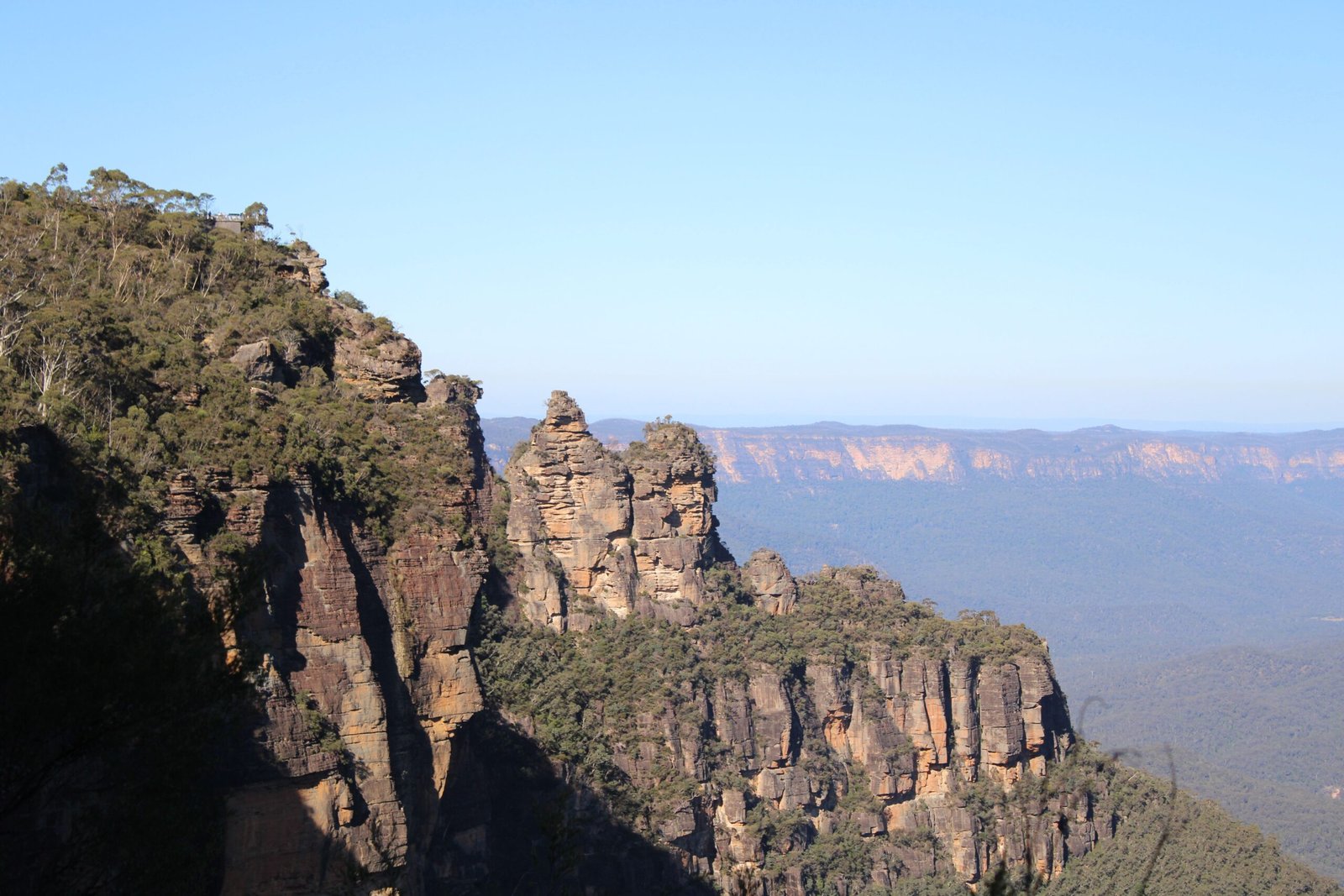
Echo Point in Katoomba is the most visited place in the Blue Mountains, and for good reason. From the lookout, the Three Sisters, Meehni, Wimlah and Gunnedoo, stand out from the cliff edge above the Jamison Valley, which stretches away to the south in layers of blue and green. The Sisters are named in Aboriginal legend as three sisters who were turned to stone, and they are a sacred place for the Gundungurra people. The best time to visit is early in the morning, before the tour buses arrive, or late in the afternoon, when the light is warm and the valley is at its most dramatic.
From Echo Point, the Prince Henry Cliff Walk runs east towards Leura and west towards the Giant Stairway, which descends more than 800 steps to the valley floor. The Three Sisters Walk leads to a small lookout at the base of the Sisters, while the Federal Pass and the Dardanelles Pass cross the valley floor through rainforest and past waterfalls. Scenic World, a short drive from Echo Point, offers a cableway, a railway and a walkway through the rainforest, and it is a good way to experience the valley from below. Allow at least half a day for Echo Point and the surrounding walks, and bring water, sun protection and sturdy shoes.
Wentworth Falls, Leura and the Best Walks
Wentworth Falls, the town and the waterfall, is one of the highlights of the Blue Mountains. The waterfall drops in three tiers down a cliff face, and the Wentworth Falls Track, the National Pass and the Valley of the Waters Walk form one of the most popular walking circuits in the region. The National Pass is a historic trail that was cut into the cliff face in the early 1900s, and it offers superb views of the falls and the valley. The Valley of the Waters, with its series of waterfalls and rock pools, is a beautiful walk in its own right, especially after rain.
Leura, just east of Katoomba, is a charming village with a main street lined with cafes, gardens and shops, and it is a good base for exploring the eastern side of the mountains. The Leura Cascades and the Prince Henry Cliff Walk are easy walks from the village, while the nearby Gordon Falls and the Pool of Siloam offer quieter alternatives. Blackheath, to the west, is the starting point for Govetts Leap, a spectacular lookout over the Grose Valley, and for the Grand Canyon Walk, a loop that descends into a narrow canyon of rainforest, ferns and sandstone walls. Each of these walks shows a different side of the mountains, so plan for at least two or three days if you want to walk properly.
Jenolan Caves, Wildlife and the Wider Region
Jenolan Caves, about an hour south of Katoomba, are among the oldest and most beautiful cave systems in the world, with underground rivers, limestone formations and guided tours through chambers such as the Lucas Cave, the Imperial Cave and the Temple of Baal. The caves are set in a deep limestone valley, and the drive there is scenic, with views of the Blue Mountains and the surrounding farmland. Allow a full day for the trip, and book cave tours in advance, because they can sell out, especially on weekends and in school holidays.
Wildlife is common in the Blue Mountains, and you are likely to see kangaroos, wallabies, wombats, lyrebirds, cockatoos and kookaburras, especially in the early morning and late afternoon. The forests are dominated by eucalyptus, with rainforest in the sheltered valleys, and the wildflowers in spring are spectacular. The region is also home to the Wollemi pine, a rare tree that was thought to be extinct until it was discovered in a remote canyon in 1994. The mountains are a place to slow down, to watch the light change on the cliffs and to listen to the birds, rather than to rush from one viewpoint to the next.
Best Time to Visit the Blue Mountains
The Blue Mountains are a year round destination, but the best times to visit are spring, from September to November, and autumn, from March to May. Spring brings wildflowers, mild temperatures and clear days, while autumn brings cool air, golden leaves and the famous Leura Gardens Festival. Summer, from December to February, is warm and can be hot, with temperatures often reaching 30 degrees Celsius, and it is also the busiest time, especially around Christmas and New Year. Winter, from June to August, is cold, with frosts and occasional snow on the higher peaks, but the days are often clear and crisp, and the valleys are at their most atmospheric.
For the best light and the fewest crowds, visit on a weekday and start early, when the valleys are often filled with mist and the sun is low. The mountains are popular on weekends, especially in spring and autumn, so book accommodation in advance if you plan to stay overnight. Rain can fall at any time, and the weather can change quickly, so check the forecast, bring a rain jacket and be prepared for cooler temperatures than in Sydney, especially in the evenings. The mountains are beautiful in all seasons, so the right time depends on what you want to see and do.
How to Get to the Blue Mountains and Get Around
The easiest way to reach the Blue Mountains from Sydney is by train. Trains leave from Central Station and take about two hours to Katoomba, with stops at Leura, Wentworth Falls and Blackheath. The train is comfortable, scenic and cheap, and it is a good option if you do not want to drive. By car, the drive from Sydney takes about 90 minutes to two hours, depending on traffic, and the Great Western Highway runs the length of the mountains. Driving gives you more flexibility, especially for Jenolan Caves and the more remote lookouts, but parking at Echo Point and Wentworth Falls can be difficult on weekends.
Once you are in the mountains, the Blue Mountains Explorer Bus runs a hop on hop off service between the main attractions in Katoomba and Leura, and local buses connect the towns. Many visitors also use taxis, rideshares or guided tours, especially for day trips from Sydney. Walking is the best way to explore the cliff tops and valleys, and the towns themselves are easy to explore on foot. If you plan to hike, check the track conditions with the National Parks and Wildlife Service, because tracks can close after rain, fire or rockfalls, and always carry water, a map and a charged phone.
Where to Stay in the Blue Mountains
Katoomba is the main base for most visitors, with the widest choice of hotels, guesthouses, hostels and apartments, and easy access to Echo Point, Scenic World and the cliff walks. It is lively, convenient and well connected by train, and it has plenty of cafes and restaurants. Leura is quieter and more elegant, with boutique hotels, bed and breakfasts and a village feel, and it is a good choice for couples and for a slower stay. Blackheath is the quietest of the main towns, with a village atmosphere, a good pub and easy access to Govetts Leap and the Grand Canyon Walk.
For a more immersive stay, consider a cottage, a cabin or a farm stay in the surrounding valleys, or a hotel with a view over the Jamison Valley. Camping is available in the national park, although it is basic and requires a permit, and there are also caravan parks and hostels for budget travellers. Book well ahead for weekends, school holidays and the autumn and spring festivals, because the mountains are popular year round. Wherever you stay, try to choose a place within walking distance of a lookout or a trail, so you can enjoy the early morning and the evening light without driving.
Practical Tips for Visiting the Blue Mountains
Pack for changeable weather, with layers, a rain jacket, sturdy walking shoes, sun protection and a hat. The mountains are cooler than Sydney, especially in the mornings and evenings, and the temperature can drop quickly when the sun goes down. Carry plenty of water on walks, because there are few places to refill in the valleys, and tell someone your plans if you are hiking alone. Mobile reception is patchy in the valleys, so download maps in advance and do not rely on your phone for navigation.
Respect the cliffs and the valleys, stay on the marked tracks, do not climb over safety barriers and do not feed wildlife. The sandstone cliffs are fragile, and rockfalls are a real risk after rain, so follow any closures and warning signs. The Three Sisters and the surrounding landscape are sacred to Aboriginal people, so treat them with respect and learn about their significance before you visit. Finally, give yourself time. The Blue Mountains are not a place to rush, and the best moments are often the quiet ones, a misty morning, a lyrebird calling in the forest, or the sun setting over the Jamison Valley.
If you liked the Blue Mountains, you will also enjoy our guides to Great Smoky Mountains and to Snowdonia.
Conclusion
The Blue Mountains are one of Australia’s great natural treasures, and they are remarkably easy to enjoy. Their cliffs, valleys, waterfalls and forests offer a sense of scale and wilderness that is rare so close to a major city, while their villages add warmth, food and culture to the experience. Stand at Echo Point at sunrise, walk the National Pass in the afternoon and watch the light fade over the Grose Valley from Govetts Leap, and you will understand why the mountains have inspired artists, writers and walkers for generations. Plan for at least two days, walk as much as you can, and let the blue haze work its magic.
Frequently Asked Questions
How far are the Blue Mountains from Sydney?
The Blue Mountains are about 100 kilometres west of Sydney. The train from Central Station takes about two hours to Katoomba, and the drive takes about 90 minutes to two hours, depending on traffic.
Can I visit the Blue Mountains as a day trip from Sydney?
Yes, a day trip is possible, and many visitors do it by train or on a guided tour. Staying overnight is better, because it lets you see the valleys in the morning and evening light and gives you time for longer walks.
What are the Three Sisters?
The Three Sisters are three sandstone peaks at Echo Point in Katoomba, named Meehni, Wimlah and Gunnedoo. In Aboriginal legend they are three sisters who were turned to stone, and they are a sacred place for the Gundungurra people.
Is the Blue Mountains a good place for hiking?
Yes, the Blue Mountains have more than 140 kilometres of walking tracks, from easy clifftop walks to challenging valley descents. Popular walks include the National Pass, the Grand Canyon Walk and the Prince Henry Cliff Walk.
When is the best time to visit the Blue Mountains?
Spring, from September to November, and autumn, from March to May, are generally the best times, with mild temperatures, wildflowers in spring and autumn colours in the gardens. The mountains are beautiful in all seasons, but winter can be cold and summer can be hot and busy.